Across the country, the U.S. is experiencing a reading recession — a slide in the reading skills of students that predates pandemic school disruption, but there are several relative bright spots in California that include the Modesto, Compton and Los Angeles school districts, researchers say.
Harvard, Stanford and Dartmouth scholars analyzed state test scores from third to eighth grade for more than 5,000 school districts in 38 states, allowing comparisons across school districts and states in a national Education Scorecard.
What they found was sobering: Only five states plus the District of Columbia had meaningful growth in reading test scores from 2022 to 2025, the period when schools faced the challenge of recovering from pandemic-era setbacks. Like most states, California reading scores declined.
The results in math were better, with most states showing improvement over that period.
Researchers were able to pull adequate data from 35 states to compare reading scores, with California ranking 29th in academic growth. California ranked 19th in academic growth among the 38 states with adequate math data.
One way to gauge the the progress is to look at how much students learned in a typical year of instruction.

Teacher Nancy Barajas points to a method of tracking student growth and success during her class at Fairview Elementary School on May 6, 2026, in Modesto.
(Annie Barker / Associated Press)
Nationally, students remain nearly half a grade level behind pre-pandemic reading scores from 2019 and only slightly better in math.
In California, students are about a third of a year behind pre-pandemic levels in reading. In math it is about a quarter of a year behind, the study showed. A quarter-year of instruction translates to about 45 school days or about nine weeks of the school year.
Reading test scores have been falling since 2013 for eighth-graders and 2015 for fourth-graders — well before the COVID-19 pandemic, according to the National Assessment of Educational Progress, also called the Nation’s Report Card, which tests a sample of students from across the country.
“The pandemic was the mudslide that had followed seven years of steady erosion in achievement,” said Thomas Kane, a Harvard professor who helped create the Education Scorecard.
Still, some states and school districts are making progress — and a common factor was a shift toward phonics-based instruction and providing extra support in other ways as well for struggling readers.
The picture is brighter in math, where almost every state, including California, saw improvements in math test scores from 2022 to 2025. Student absenteeism also declined in most states.
Bright spots in California
The new analysis validated in a national comparison what became evident in California’s own testing system: In L.A. Unified, students surpassed pre-pandemic state test scores in both reading and math. The improvement was broad-based and included English learners, Black students, Latino students and students with disabilities.
“Los Angeles Unified has remained focused on ensuring every student has access to strong literacy instruction, targeted academic support, and high-quality learning opportunities,” said Acting Supt. Andres Chait, who credited the work of teachers, phonics-based learning and actions including stronger intervention for struggling students.
In L.A. Unified, the percentage of students who scored as proficient or better on state tests was a little lower than the state‘s. But scores are improving at a faster pace. In reading, the figure was 46.5% for L.A. Unified and 48.8% for the state. In math, the figure was 36.8% for L.A. Unified and 37.3% for the state.
In Compton, students have now surpassed the state’s averages, with 51% of students proficient or better in English Language Arts; 41.1% in math. In terms of improvement, Compton soared above nearly all the nation’s school systems.
“Our continued success is not the result of a single initiative or short-term recovery strategy, “ said Compton Supt. Darin Brawley. “It has been the result of building a coherent instructional system centered on high expectations, continuous improvement, frequent formative assessment, rapid intervention…. During and after the pandemic, we did not lower rigor. We strengthened instruction.”
Another outpost of progress is Modesto City Elementary School District.
Reading and math scores in the Central Valley school system of about 15,000 students have increased consistently over the last several years.
The district revamped reading instruction during the pandemic, and math a couple of years earlier. The effort included creating a new department to help students who are still learning English. Schools also ramped up teacher training, paying educators $5,000 to complete an extensive phonics-based “science of reading” program.
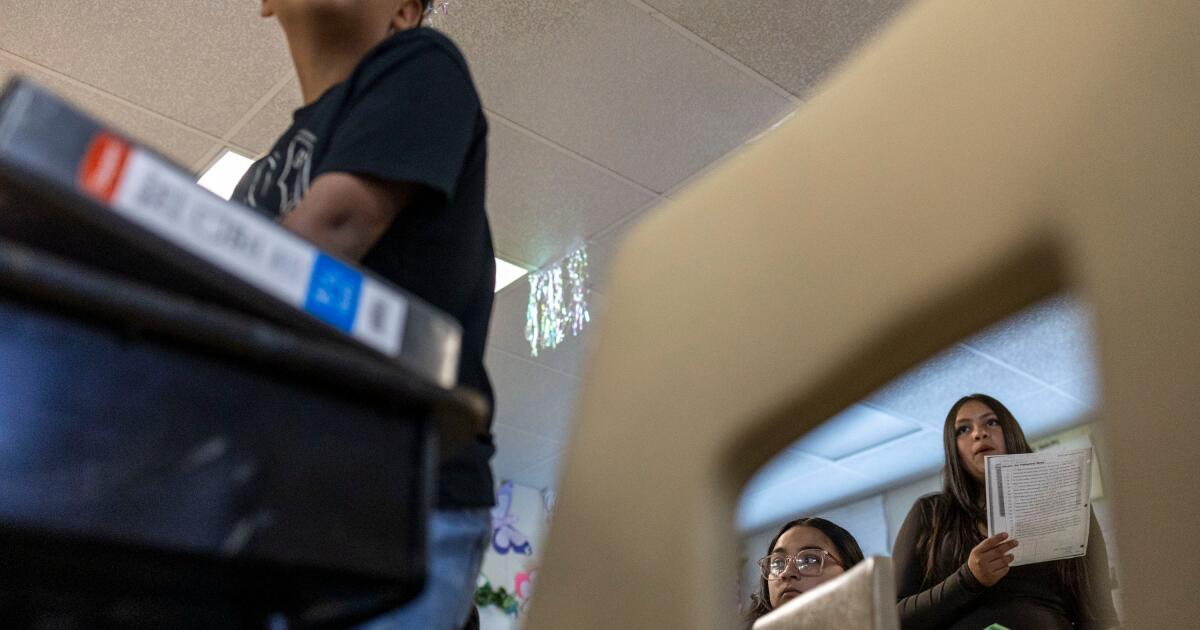
At Fairview Elementary, for example, students practice reading speed and fluency daily in the classroom of sixth-grade teacher Nancy Barajas. Students learning English are paired with native English speakers, and each child gets a turn reading with Barajas.
“Eventually, you get through the word like it’s water,” one boy in Barajas’ class said. “You just say it smooth.”
Modesto’s test scores grew enough to represent an extra 18 weeks of learning in math and 13 weeks in reading. Nevertheless, the district still has a ways to go: Overall scores remain far below grade level.

Sixth-graders read a passage and give constructive feedback to their partners during class in Modesto.
(Annie Barker / Associated Press)
A shift toward phonics
Researchers are still debating the reading recession’s causes — as well as which elements have been most crucial in the districts with beyond-the-norm improvement.
One possible factor in the downward slide, researchers say, is the rise of social media on smartphones and corresponding declines in recreational reading.
States have also backed off on strict consequences for schools whose students fail to make progress on standardized tests, Kane said.
The states that improved reading scores — Louisiana, Maryland, Tennessee, Kentucky and Indiana — had one thing in common: They ordered schools to teach with a phonics-based approach known as the “science of reading.”
For the last decade, the South has stood out as a region leading the way on phonics-based education reforms and some research-based math reforms. Louisiana and Alabama were the only states where math scores were higher in 2025 than pre-pandemic. Louisiana is also the only state that beat its pre-pandemic average in reading.
For years, schools taught reading using approaches that de-emphasized phonics and encouraged strategies such as guessing words based on context clues. As reading scores tumbled over the last decade, parents, scholars and literacy advocates pushed for teaching methods that align with decades of research about how kids learn to read — largely by sounding out words.
Along with changing teaching methods, states — including California — have also required schools to screen for learning disabilities such as dyslexia and hire coaches to help teachers improve their reading instruction.
That said, “science of reading” reforms did not guarantee success. Some states, including Florida, Arizona and Nebraska, changed parts of their reading instruction but still saw test scores fall.
Lurye and Gecker write for the Associated Press.