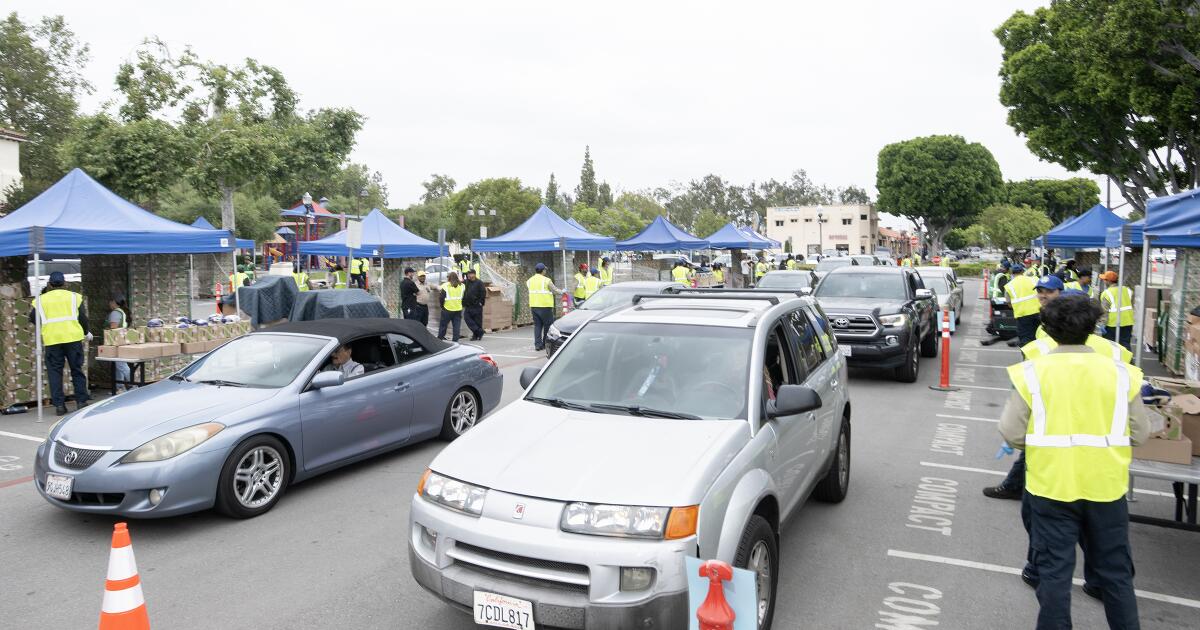
Before the sun even rose, cars began lining up along Baldwin Park Boulevard, where drivers sat waiting patiently for their chance at free groceries when the distribution event began several hours later.
Their sense of urgency was warranted. Volunteers started distributing supplies at 8:45 a.m. Wednesday, and by 11:30 a.m. all 2,000 boxes were gone, according to the Los Angeles Regional Food Bank.
Bumper-to-bumper traffic continued to line the surrounding streets, and scores of people were turned away empty-handed.
“To know that people are lining up as early as 5 o’clock in the morning, because it’s that important to them, tells me that the need is just so great,” said L.A. County Supervisor Hilda Solis, “and it’s unfortunate that we don’t have enough for everybody.”
Solis’ office organized Wednesday’s drive-through food distribution as part of a partnership launched last month with the Los Angeles Regional Food Bank to address growing food insecurity in her district.
Although food insecurity is a longstanding problem in L.A. County, the issue has taken on new urgency as inflation nationwide has surged.
On Tuesday, the U.S. government announced that the inflation rate had hit a three-year high in April as the war on Iran raised the cost of energy.
Gas prices have spiked by more than $1.50 across the U.S. in just over two months, hitting a national average of $4.50 a gallon and an average of $6.15 a gallon in California, according to the American Automobile Assn. In April, grocery prices rose by 0.7%, the biggest one month jump in nearly four years, as meat, dairy and produce all saw notable cost increases, according to data from the Bureau of Labor Statistics.
The latest price jumps are putting additional pressure on the already strained budgets of many households — particularly working-class families, seniors relying on Social Security and those living on disability payments, said Michael Flood, president and chief executive of the Los Angeles Regional Food Bank.
“It does feel like the pot is continuing to boil and slowly boiling over,” said Flood.
The sudden loss of jobs and income during the pandemic thrust food insecurity into the spotlight in 2020, and there has been limited relief since then as the inflationary period following the pandemic shattered consumer price records across the nation, he said.
In January 2025, the food bank saw an uptick in demand when thousands of Angelenos were displaced by wildfires. This was followed by the Trump administration’s crackdown on immigration, which disrupted income for many families and businesses serving the immigrant community.
Then, in the last quarter of the year, the government shutdown led to a delay in the distribution of federal food aid, continuing to increase demand for help putting groceries on the table.
One in four households in L.A. County reported struggling to afford enough food in 2025, according to a study from the USC Dornsife College of Letters, Arts and Sciences.
“We were hoping that in 2026 demand would ease off a little bit as 2025 was this incredible year with a lot of things happening, but we’re not seeing it,” said Flood. “We’re seeing in 2026 that demand is still very strong.”
That need was on clear display at Wednesday’s food distribution event. Solis spoke to several of the people who attended the giveaway and said some are choosing between putting gas in their car and food on their table.
“Another woman that I talked to told me that this was going to be very helpful, because her husband had just been detained by ICE and he was a sole supporter,” said Solis. “She did not have a job, and she was helping to maintain their three young children.
“Just to hear the words and stories from these family members is heartbreaking,” she added.
Her office has allocated $1 million of discretionary funding to host four large drive-through food distribution events with the food bank as well as a handful of smaller giveaways. The next drive-through will be held May 29 at the Montebello Golf Course from 9 a.m. to 12 p.m.