New Yorkers tend to know a bad landlord when they see one. Now they have official criteria to go by.
The head of the mayor’s tenant office, Cea Weaver, defined a “low-road landlord” as “one that is persistently unavailable to their residents, who is buying their buildings with a speculative intent…and ones that are not responsive to the city or the residents when there are problems and they need to be resolved.”
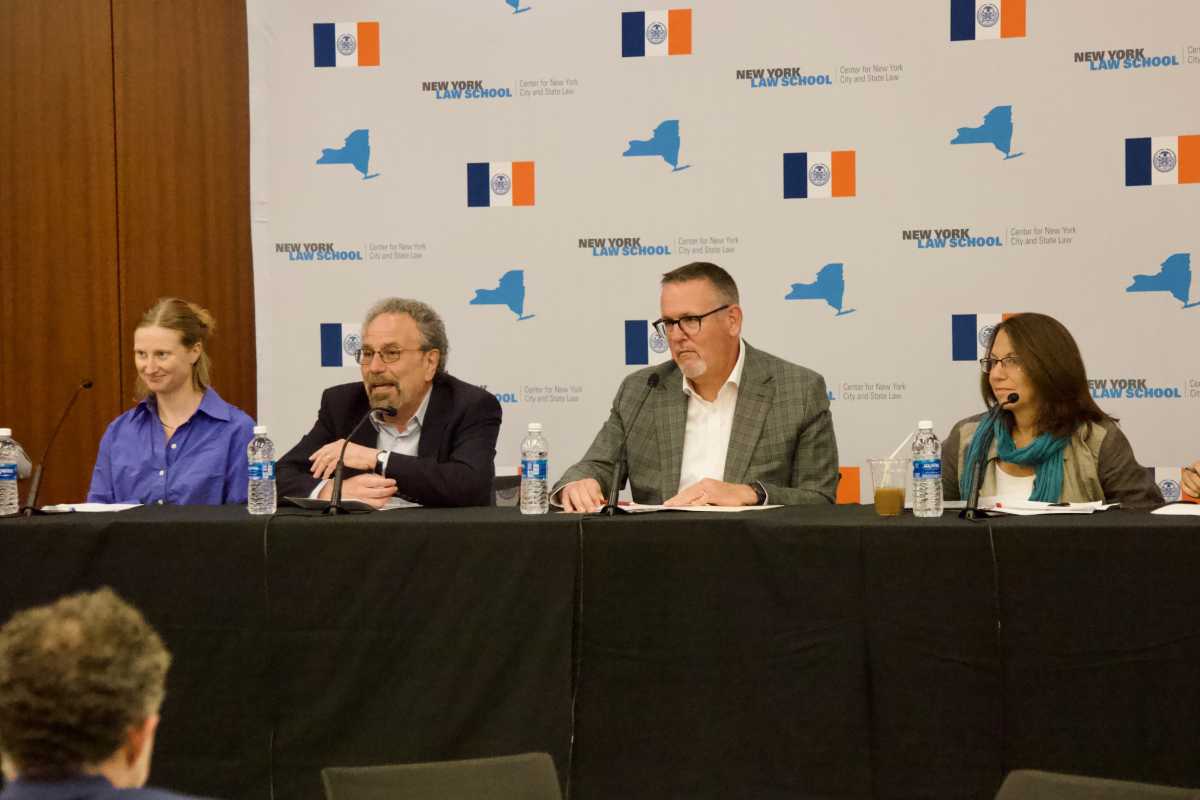
The answer came in a recent New York Law School housing panel around the philosophical question: “What is rent?” Weaver sat down with two executives representing rent-stabilized owners and developers at the event, which aimed to discuss how much control the city government actually has over rent in various forms of housing.
And though the Mamdani administration’s support for a freeze on rent-stabilized increases has rankled some affordable housing owners, the two sides agreed in the law school housing panel that there are bigger issues facing New York’s affordable housing stock.
“The difference between a 0% increase and a 2% increase is not moving the needle,” said Rafael Cestero, the head of an affordable lender called the Community Preservation Corporation. “Is it making it marginally worse for the period of the freeze? Yes, for sure, but it is not the fundamental problem.”
 Joshua Rodrigues shares his story with Cea Weaver during the first “Rental Ripoff Hearing,” Downtown Brooklyn, February 26, 2026.Photo by Adam Daly
Cestero blasted the cost of insurance and a broken property tax system as the real problems that are pressing down on the city’s rent-stabilized housing stock, and seemed to find agreement in Weaver that much of the city’s aging affordable housing, which often dates back decades, is at risk of not getting the repairs it needs to keep operating.
According to his organization’s data, operating expenses for rent-stabilized buildings have increased at a rate of 27% since 2020 — with insurance costs up 75% during that period of time.
Citing that data, Weaver pointed out that given an increasing number of rent-stabilized tenants who are not able to pay their rent as it is now, it would be totally infeasible to try and make up those operating expenses with rents.
“That means we need to find another solution here and I think for different buildings it will look a little bit different,” Weaver said, suggesting that for more distressed buildings, the city can use tax relief programs to lend them financial support.
As moderator Janaki Chadha pointed out, housing stock is often in the worst shape in places like the Bronx, where the low-income tenants are perhaps the least able to absorb a rent increase.
“We can’t pretend that low-income renters can spend more and more in order to keep up with escalating costs, but we also can’t pretend that the buildings they live in are going to remain in good condition if we don’t find ways to support the ongoing costs of maintaining those buildings,” said Howard Slatkin, executive director of the Citizens Housing and Planning Council.
In contrast to her definition of a bad landlord, Weaver also described a “high-road landlord” who has serious problems in their building but is trying to work with the city to find a policy solution that can make life better for their tenants.
Michelle de la Uz, the executive director of affordable housing nonprofit Fifth Avenue Committee, agreed with that definition, but pointed out that the Mamdani administration has its work cut out for it to effectively execute its housing programs.
“There would be more folks that would fall into the high road landlord category if they felt that the bureaucracy was working, working for them or that somehow stepping forward that there was consistency in how policies were applied,” de la Uz said.