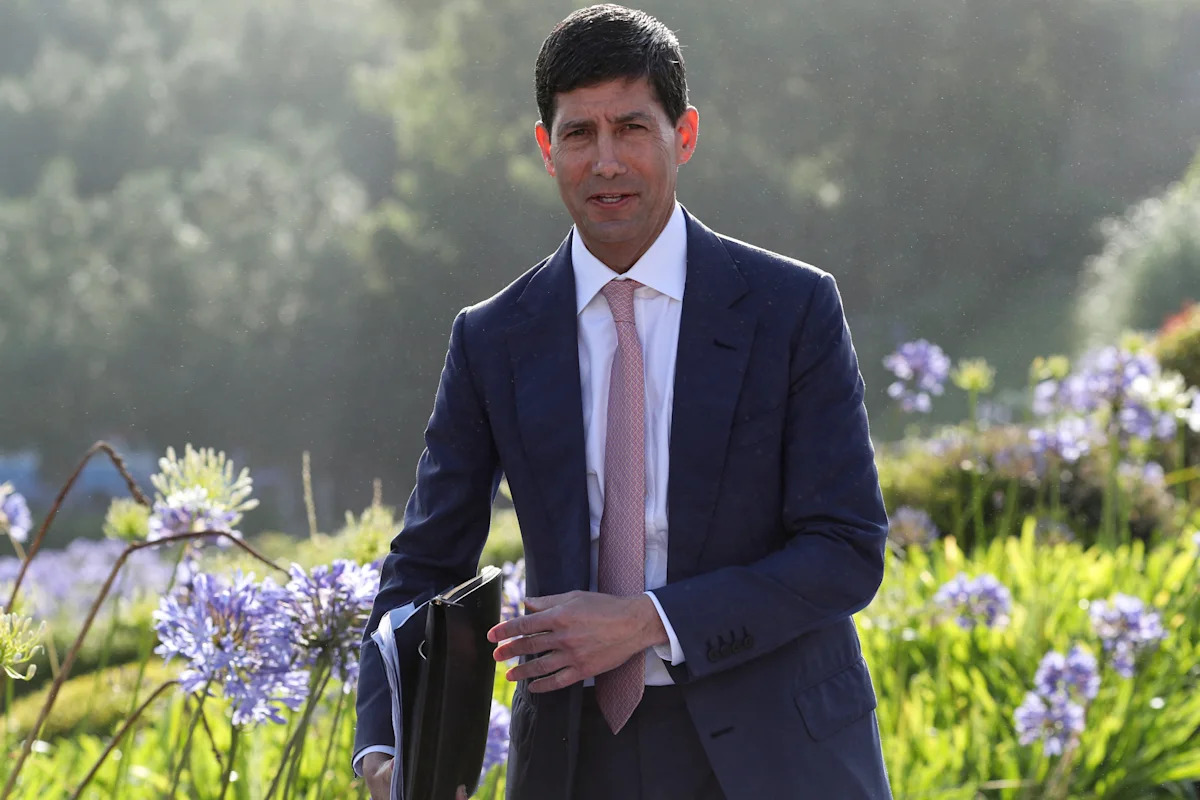
Federal Reserve Chair Kevin Warsh doubled down on the central bank’s commitment to bring down inflation in his first comments since his inaugural press conference two weeks ago.
“We’ve all looked around, and we’ve seen that prices are too high,” Warsh said on a panel in Sintra, Portugal, at the European Central Bank forum on central banking.
“If there were people in the household or the business sector and the financial markets who thought that this central bank was going to be comfortable with an inflation objective above 2%, well, I guess they’d be disappointed. We’re going to deliver price stability in the US.”
Warsh, however, noted that expectations of inflation over the first four months of the period have come down, as have inflation risks. When asked whether the central bank will do what it needs to rein in inflation regardless of President Trump’s desire for low rates, Warsh said, “We’ve been an independent central bank for a very long time. We’re going to be an independent central bank at this moment, and you’re going to see no changes on that.”
Warsh made a splash two weeks ago when he came out markedly more hawkish than markets expected, affirming the Fed’s commitment to price stability repeatedly during his press conference but without offering any forward guidance. That’s the public communication that telegraphs the likely direction of monetary policy and interest rates, which Warsh has said he wants to curtail.
Oil prices have plunged since President Trump announced a tentative deal with Iran, but there have been stops and starts in negotiations and renewed strikes from both sides, raising questions about the path of energy prices and subsequent impact on inflation. At the same time, artificial intelligence appears to be pushing up inflation. Core inflation, which excludes volatile food and energy prices, has also moved higher.
The Fed’s preferred inflation gauge, the Personal Consumption Expenditures index excluding volatile energy and food prices, rose to 3.4% in May, marking the highest level since October 2023.
Fed officials see inflation rising 3.6%, compared with 2.7% previously, on a headline basis. On a “core” basis, officials see inflation at 3.3%, compared with 2.7% previously.
Warsh on Wednesday reiterated his determination not to offer guidance about the outlook for interest rates.
“I said I’m not going to give forward guidance because we’re meeting in 6 weeks, but I have an update for you, we’re meeting in 4 weeks,” Warsh said.
“I want us to have a good family fight… When we get into that room and shut the door, we’re going to have a good debate, but I don’t have much more for you than that.”
Warsh also didn’t tip his hand on the impact of artificial intelligence and whether it’s inflationary, only noting that it’s now being seen in the demand side of the economy and that he’s “confident we’re going to see it in supply at some point.”
“It’s up to the central bank to decide whether it’s inflationary, whether in fact it finds its way into a broader set of goods,” Warsh said.
Jennifer Schonberger is a veteran financial journalist covering markets, the economy, and investing. At Yahoo Finance, she covers the Federal Reserve, Congress, the White House, the Treasury, the SEC, the economy, cryptocurrencies, and the intersection of Washington policy with finance. Follow her on X @Jenniferisms and on Instagram.
Click here for the latest economic news and indicators to help inform your investing decisions
Read the latest financial and business news from Yahoo Finance