
Ricardo Hidalgo served in the United States Marine Corps and later set out to make a living driving trucks. Now retired and the director of Houston’s Teamsters Local 988, he wants to make sure that his peers earn reasonable wages and have the health benefits they need to take care of themselves and their families.
Hidalgo and members of 25 unions, representing trades from education to drywall installation, have been a consistent presence around recent World Cup events as they try to build a coalition in a time when workers are barely getting by and some are being replaced by artificial intelligence.
Last Friday, the groups marched outside of the FIFA World Cup Fan Festival in East Downtown with banners declaring, “Houston Deserves Better.”
“Houston is the fourth largest city behind Chicago, New York and Los Angeles, and we fall short when it comes to wages, healthcare, benefits and retirement plans,” Hidalgo said. “The state minimum wage is $7.25. No one can live off that. As CEOs get richer, the common worker here in Houston is seeing pennies on the dollar in comparison to what corporations are making.”
About 6 percent of Houston’s workforce is represented by a union, Hidalgo said. In hopes of increasing their numbers, union leaders have been taking contact information from workers who are interested in joining. To date, nearly 1,000 people have signed a pledge card in support of the Houston Deserves Better campaign.
Hilton Americas workers went on a 40-day strike last year and, represented by UNITE HERE Local 23, successfully negotiated higher wages and better working conditions. Other industries, however, due to contractual obligations, can’t even use the word “negotiate” and are forbidden from going on strike.
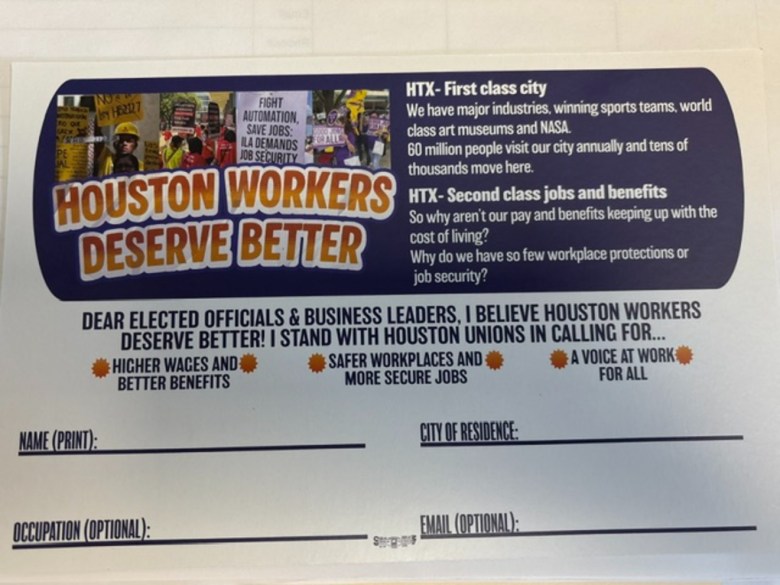 About 1,000 people have signed pledge cards in support of local labor unions’ Houston Deserves Better campaign. Credit: Screenshot
The Houston Deserves Better effort is not to be confused with marches by UNITE HERE Local 23 outside Shell Stadium in May, specifically advocating for fair wages for World Cup concession workers. Some stadium workers make $10 an hour and most make less than $15 an hour, according to a UNITE HERE Local 23 representative.
Hany Khalil, executive director of the Texas Gulf Coast American Federation of Labor, said at a June 24 press conference that FIFA’s selection of Houston as a host city for the World Cup was a “no-brainer,” because Houston has the infrastructure, diversity and workforce to support such a large event. He commended the Houston Host Committee for developing a robust human rights plan that addressed concerns around workers’ rights.
“Houston came into this World Cup with a strong set of standards to protect workers’ wages, safety and dignity on the job,” Khalil said at the time. “We want to be clear that this is a start and not the finish line. We are inviting Houstonians and World Cup fans to ask local elected officials and business leaders to make sure Houston workers see the economic benefits of our city’s growing economy.”
Hidalgo said he absolutely supports fair pay for the thousands of temporary workers assigned to the soccer matches and ancillary events, but the coalition he and others are building is bigger than that, and their work will continue long after the World Cup ends on July 19.
“We’re on a mission,” Hidalgo said. “We’re trying to gather and gain support. That’s why we had that rally last Friday. We want to gain more momentum and then we want to have a conversation with elected leaders. We’re going to invite the corporations and companies that are willing to sit with us.”
Harris County is the most uninsured county in the United States, Hidalgo said. Unions can negotiate for lower deductibles so a worker pays a low percentage — or zero percent — of a premium. “What we’d really like to do is have the employer pay a little bit more and come into a union-provided healthcare plan like TeamCare,” he said. “We’re negotiating contracts so our members receive good medical benefits so they don’t have to use public assistance or the emergency room as their medical plan.”
 Union members gathered outside the FIFA World Cup Fan Festival last week to raise awareness about workers’ needs. Credit: Faith Coates
The coalition of unions is also concerned about recent shifts to autonomous vehicles and AI robots doing the work that people used to do, Hidalgo said.
“We try to negotiate guardrails around the amount of automation that can be done,” he said. “There are autonomous trucks on Texas highways right now. That’s just in our industry, but we’re a coalition of unions throughout Houston and Harris County. We’re trying to be a sounding board to not just elected officials but to employers and bring awareness about wages, benefits and automation.”
Related