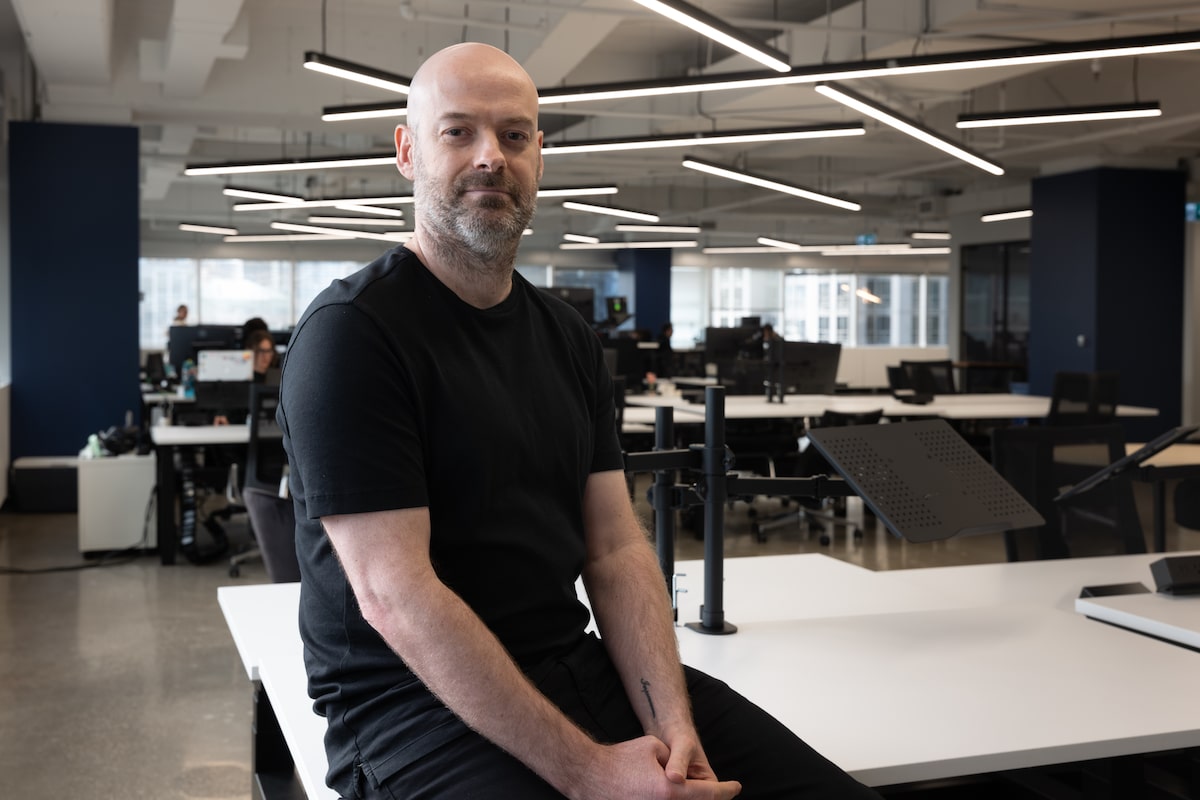
Christian Weedbrook, founder and CEO of Xanadu, says the new facility will play a key role in making the company’s data-centre dreams a reality.Supplied
Toronto quantum startup Xanadu Technologies Inc. officially opened a new facility Monday that will allow it to package its world-leading chip technology in house.
Packaging is the final step in the manufacturing process of a chip and provides the mechanical environment in which it operates. While Xanadu previously outsourced this to facilities in other countries, the company can now dice, polish, package and bond its own chips in the same building it already operates out of in downtown Toronto.
This is a key step for the firm, which has the goal of establishing a quantum data centre in Toronto in 2029. Earlier this month, Xanadu reported a new milestone in its effort to develop a form of light-based quantum computing that can operate at commercial scale: creating a single chip that contains an error-detection code in a pulse of laser light.
This breakthrough is significant because it makes it possible to envision a quantum-computing system operating at the scale of a data centre, said Christian Weedbrook, chief executive officer and founder of Xanadu.
Now, one more step of the journey for these chips, critical to making the data centre a reality, will take place in Canada.
Canada’s Xanadu achieves worldwide first with error-resistant quantum chip
Canadian company Xanadu tests building blocks for commercial quantum computer
“It’s a sovereign technology. It’s important for Canada. It’s important for us as a nation,” Mr. Weedbrook said.
After eight months spent constructing the new facility, he said, the requests from other companies across the world to use it have already started pouring in.
Within the next month or two, Xanadu will begin outsourcing its facility to other companies and universities, Mr. Weedbrook said. The demand is so great it will operate 24/7.
“This is really important to our AI and quantum sovereignty,” Evan Solomon, Canada’s Minister of AI and Digital Innovation, said at a ribbon-cutting ceremony on Monday.
Yet, the location and appearance of the $10-million packaging facility contradict its world-class status.
Xanadu occupies two upper floors in a tower at the corner of Bay Street and College Street, but employees must take the service elevator down to P1 to enter their new space.
Formerly a storage area in the parking level, the basement location sits beside Dollarama and close to a Farm Boy bakery. In the vestibule, where visitors must don boot covers, the smell of freshly baked bread wafts in the air.
Part of the reason for its subterranean location is the sheer mass of the machines needed to perform the tasks at hand. One of them, where the chips are bonded to a substrate as the finishing step, weighs 3.5 tonnes.
Andrey Goussev, head of hardware operations at Xanadu, said the company considered having the machinery delivered to its lab upstairs via crane, but that would have required the shutting down of Yonge Street, among other logistical difficulties.
“We had to get a structural engineer to verify that we were actually allowed to wheel it in here in the first place,” he said, referring to the basement space.
To limit the number of dust particles floating around the space, staff must wear lab coats or full-body suits, and to prevent static-electricity buildup, special electrostatic dissipative shoes are worn. The air in the room is also cycled through every five minutes. Each of these measures helps protect the sensitivity of the chips.
As Mr. Solomon highlighted Monday, Xanadu owns the intellectual property for its packaging process. Aside from the fabrication of the wafers used to create the chips, the Canadian company has full control over its entire chip-making process.
Mr. Weedbrook said the new packaging facility plays a key role in ensuring Xanadu has the quality of chip necessary to make its data-centre dreams a reality.