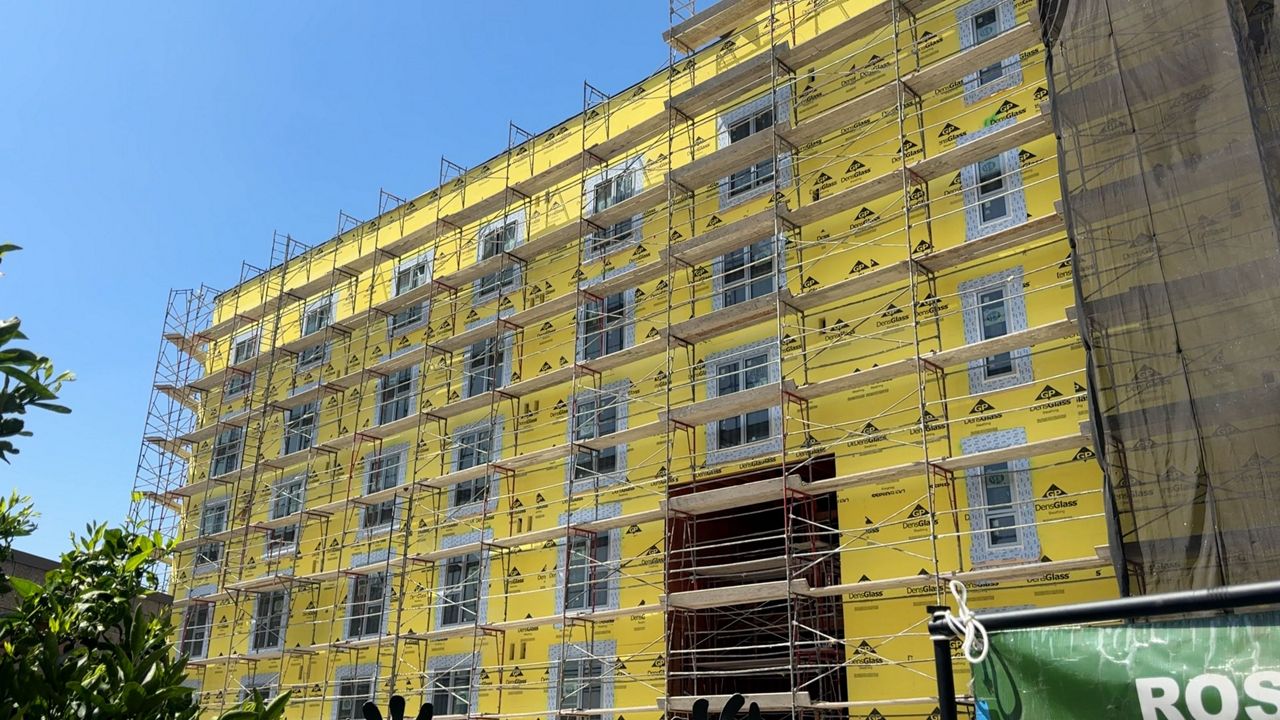
LOS ANGELES — In the midst of the homelessness crisis on Skid Row, there is a new, towering sign of hope: Rosa’s Place. At the corner of Fifth and San Pedro, construction of 97 new apartment units is well underway, an expansion of the Downtown Women’s Center.
“Next fall, in 2027, 97 women and survivors of gender-based violence will move into these apartments, and it will help them heal from the trauma of experiencing homelessness,” Downtown Women’s Center CEO Amy Turk said.
“Rosa’s Place” is named after Rosa Arzola, the woman who inspired Jill Halverson to found the Downtown Women’s Center almost 50 years ago. Recently, Halverson was visiting the DWC to mark the project’s halfway point.
“She was a woman who lived on Skid Row, and she pushed a shopping cart. I met her and identified with her because she liked to cook and I liked to cook, and she would build a fire and cook over a little fire on the sidewalk,” Halverson said of Arzola.
Halverson was already working on Skid Row at the time, but seeing Arzola on the streets made her realize how few resources there were for women.
“I thought I could create a space where women could come in, be safe, get something to eat, take a shower and be on their way,” Halverson said.
The DWC became much more. Today, they operate 151 permanent housing units across LA for women and survivors of gender-based violence. Rosa’s Place will almost double its permanent supportive housing.
As services have expanded, so too has the need. This year’s homelessness count numbers, recently released by the Los Angeles Homeless Services Authority, found that there are 22,232 women experiencing homelessness in Los Angeles County.
“Service providers were not surprised that the number of people experiencing homelessness went up. We were not surprised because we saw funding get cut right and left, from the state level, from the county, and from the city,” Turk said.
Providers worry construction of more projects, like Rosa’s Place, might be delayed by further funding suspensions or budget cuts. It’s permanent supportive housing that DWC resident, Suzanne Lugo, 72, says changed her life.
“Being here, you get that support you need to move on. It takes time. It’s not easy, but once I got here, I felt very secure. I started to build up my self-esteem,” Lugo said.
For Turk, building up self-esteem comes down to community and a safe home of one’s own.
“What I know we need is to sustain our funding for permanent housing, for permanent solutions,” she said.