SScience Read More Study Challenges Popular Theory on Why Primordial Bugs Were So Darn HugeMarch 27, 2026 About 350 million years ago, dragonflies were roughly 27 inches (70 centimeters) wide. Scientific consensus is that high…
SScience Read More Rising atmospheric CO2 reduces nitrogen availability in boreal forestsFebruary 19, 2026 Galloway, J. N. et al. Transformation of the nitrogen cycle: recent trends, questions, and potential solutions. Science 320,…
SScience Read More A universal concept for melting in mantle upwellingsFebruary 5, 2026 Experimental apparatus All experiments were conducted in a 6–8 multi-anvil apparatus with 32 mm edge length WC cubes featuring…
SScience Read More Scientists Just Detected a Long-Lost Planet ‘Hiding’ Inside EarthOctober 17, 2025 If proto-Earth had all its parts and chemistry replaced to become the Earth we know today, can the…
SScience Read More The Moon is rusting — thanks to ‘wind’ blown all the way from EarthSeptember 23, 2025 A stream of charged particles that blows from Earth (foreground) to the Moon could account for the rust…
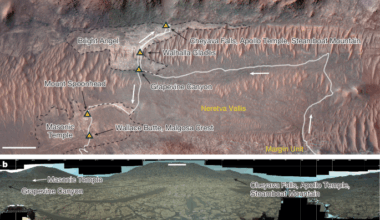
SScience Read More Redox-driven mineral and organic associations in Jezero Crater, MarsSeptember 10, 2025 Farley, K. A. et al. Mars 2020 mission overview. Space Sci. Rev. https://doi.org/10.1007/s11214-020-00762-y (2020). Farley, K. A. et…
SScience Read More New Study Fuels Debate Over World-Changing Comet Strike 12,800 Years AgoAugust 19, 2025 Roughly 12,800 years ago, as Earth was emerging from its last great ice age, temperatures in the Northern…