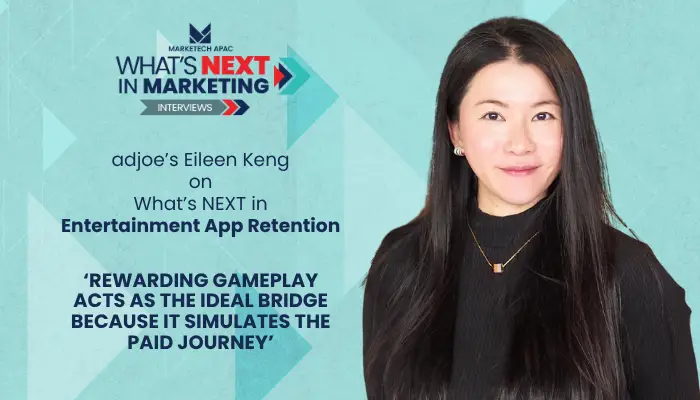
Entertainment apps have long relied on a single content moment to acquire users — a webcomic, a short drama, a manga title. But once that moment ends, so does the reason to stay. For an industry where a median of only 4% of downloads convert into trials, that gap between attention and revenue has become one of marketing’s harder problems to solve.
For this instalment, we spoke with Eileen Keng, Vice President of Revenue, APAC at adjoe, on how rewarded gaming is helping entertainment apps close that gap — turning idle attention into a retention loop, and non-paying users into a new revenue stream.
Closing the churn gap
According to Eileen, the retention problem for entertainment apps begins the moment the content itself runs out. Users are typically acquired around a single hook — a webcomic series, a short drama, a manga title — and once that content is consumed, the risk of losing them altogether spikes.
“When users finish consuming that content, they hit a paywall or wait for the next release. That’s when the churn risk increases, and apps lose their audience. Rewarding gaming is filling this churn gap naturally,” she said.
She pointed to a behavioural pattern underlying this shift: entertainment apps and mobile games are already competing for the same slice of consumer attention, and their audiences overlap far more than publishers tend to assume. Rather than treating that overlap as a threat, she argued, entertainment apps are starting to absorb it into their own retention strategy.
“I don’t think entertainment apps need to compete with that behaviour. They need ways to make it work for them. Instead of preventing users from playing games elsewhere, entertainment apps are now making rewarding gaming part of their own retention system,” she said.
Turning non-payers into revenue
Subscription fatigue has made it harder for entertainment apps to lean on paywalls alone, and Eileen sees this as opening up a bigger opportunity: monetising the majority of users who never convert into subscribers in the first place. With media and entertainment apps converting a median of downloads into trials, a large share of any app’s audience consumes content for free and generates little to no direct revenue.
She explained that the biggest obstacle to changing this isn’t awareness or interest — it’s the psychological weight of a user’s very first purchase. Rewarded gameplay, she said, offers a way around that barrier by letting users experience the paid journey before they’ve spent anything.
“Rewarding gameplay acts as the ideal bridge because it simulates the paid journey. When users earn currency through gameplay and redeem it to unlock paid episodes or exclusive chapters, they participate in a similar UX flow to a paying audience. This removes the mystery and friction of the app’s internal economy,” she said.
That familiarity, she added, compounds over time. Once users get used to consuming premium content through earned rewards, the resistance to eventually paying for it directly starts to erode — particularly at moments of peak narrative tension.
“Once users normalise consuming paid content, the psychological spending barrier drops significantly. When their earned reward balance runs out during a cliffhanger moment, they are far more likely to convert from rewarded users into direct, paying customers,” she said.
The advertiser-funded engine
Behind this model sits a straightforward funding mechanism, according to Eileen: premium mobile game advertisers cover the cost of both user rewards and publisher revenue through performance-based campaigns, meaning entertainment apps don’t need to underwrite the incentive themselves.
“It’s an externally funded model where advertisers fund the user rewards and publishers generate revenue from the engagement. adjoe Playtime results can be significant as partners achieve 1,000-2,000 eCPMs and 1.20-1.40 ARPDAU,” she said.
For entertainment apps specifically, Eileen said this translates into a revenue stream that wouldn’t otherwise exist, drawn entirely from users who were never going to subscribe.
“We’ve seen adjoe’s entertainment app partners generate five-figure daily revenue from users earning currency to unlock episodes,” she said.
Retention over reacquisition
Eileen argued that rewarded gaming also forces a rethink of how entertainment apps balance acquisition and retention spend. Most apps, she noted, are already spending heavily to bring users in — which makes what happens after that first download increasingly important to the app’s overall growth.
“If a user comes in for one short drama or manga title and leaves once they finish it, the app has to keep replacing that user with another acquisition spend. That is an expensive way to grow,” she said.
Rather than letting that engagement go to waste, Eileen said entertainment apps can convert it directly into incremental revenue and measurable retention gains, citing adjoe’s own data on repeat usage among rewarded users.
“Instead of non-paying engagement, which leads to no revenue, users can play games, earn in-app currency, and create incremental revenue for entertainment apps. And we see an impact on retention too: Playtime users return to partnering short-drama apps 3× more often than non-users,” she said.
Importantly, she added, this isn’t a case of trading one budget line for another. “It doesn’t mean spending less on acquisition, but getting more out of the users you’ve already acquired,” she said.
What’s next for entertainment apps in APAC
Looking ahead, Eileen expects entertainment apps across APAC to keep moving toward broader, hybrid formats, shaped in part by how unevenly subscription conversion performs across the region’s markets.
“Entertainment apps will increasingly move towards broader, hybrid ecosystems, particularly as subscription conversion varies across APAC markets. The lines between entertainment and gaming will continue to blur, particularly in APAC,” she said.
For adjoe, Eileen said that shift means continuing to help entertainment partners capture value from behaviour that’s already happening, rather than trying to redirect it elsewhere.
“We’ll continue working with our partners to bring gaming into the entertainment experience in a way that helps retain users and increase revenue from the engagement,” she said.
Advice for entertainment apps
Asked what she’d tell entertainment apps considering a rewarded gaming layer, Eileen was direct: treat it as a retention and monetisation loop built into the app’s core experience, not a bolt-on ad placement.
“I’d say to treat rewarded gaming as a retention and monetisation loop, not just another monetisation placement. Gameplay should create value inside the entertainment app and give users a concrete reason to return. If the reward sits outside the entertainment experience, you are adding another activity to the app,” she said.
She framed the shift less as a technical integration and more as a structural one — a change to how the entire attention loop inside the app is designed.
“Choosing a rewarded gaming solution isn’t about integrating another ad placement. It’s restructuring how users engage and the attention loop,” she said.
Ultimately, Eileen’s advice comes down to a reframe: every user’s time in the app, whether they ever pay or not, carries value worth building for.
“When you weave game-funded engagement into your app’s native economy, you build revenue from the freemium majority and build a second curve for sustainable, long-term growth. It’s where monetisation becomes a byproduct of an engaging user experience,” she said.
****
As entertainment apps across APAC compete for the same slice of attention as mobile games, Eileen’s outlook signals a shift already underway: retention is no longer just about better content, but about better use of the time users already spend outside it. If rewarded gaming continues on its current trajectory, the apps that treat gameplay as part of their core economy — rather than a bolt-on feature — may be the ones best positioned to convert their non-paying majority into their next growth curve.