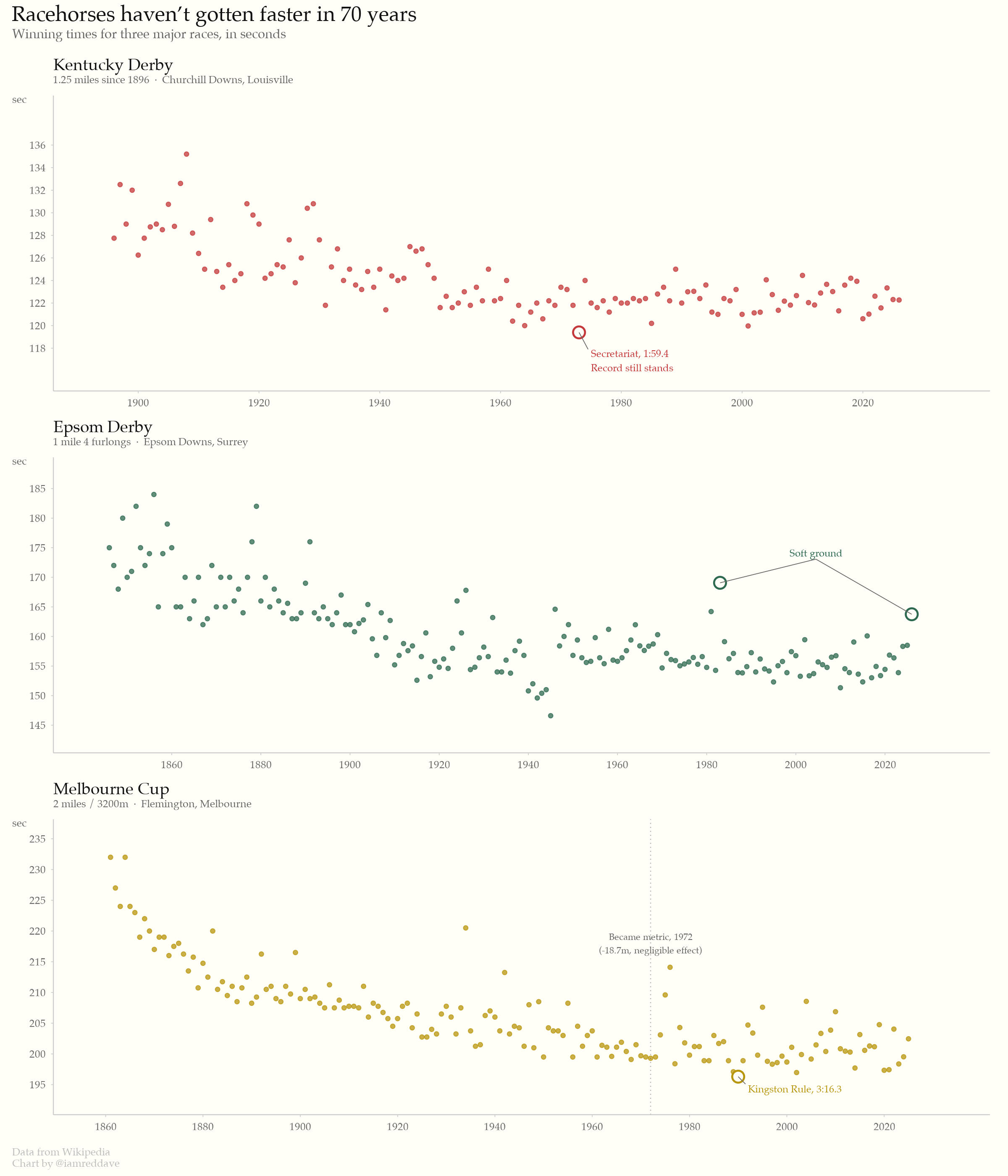
I was reading this really interesting piece about the evolution of horses The Ultimate Horse [https://worksinprogress.co/issue/the-ultimate-horse/](https://worksinprogress.co/issue/the-ultimate-horse/) and it has a graph showing that the speed of horses in these major races had plateaued. I thought it would be interesting to update it for the last 20 odd years to see if that continued.
Original paper: Historical progression of racing performance in thoroughbreds and man [https://pubmed.ncbi.nlm.nih.gov/17124853/](https://pubmed.ncbi.nlm.nih.gov/17124853/) by David S Gardner, 2006
Lazy bastards.
Okay, so now what is horse racing even trying to achieve at this point? It’s just about breeding and racing thousands of horses just to shuffle around tiny differences at the same basic level. So if it is not really about making faster horses, it starts to look like a lot of expense (and physical risk to the animals) mainly for gambling and profit … oh wait, I think I answered the question.
What happened to the Epsom derby in the early 40s? Did WWII cause slightly slow down clocks?
Now plot how many horses get put down after each race over the years…
They maxed out their support SSR cards years ago
In the Melbourne Cup horses that are perceived to be better have to carry more weight. Do your data account for this?
What horses have done over the last 70 years is fail more often. In an attempt to breed for more speed, we have breed horses that break down more often, often catastrophically during races.
That is because horse racing is gambling. You do t want a faster horse that is a safe bet. You want a race that can attract gamblers.
Horses have been selectively bred for thousands of years. Racehorses for hundreds of years. Over that period, trainers and breeders have eked out improvements in breeding and training to the point where it is probably difficult to improve further.
Humans have been improving physical training for a century. Yes, at the end of this period people can be faster higher stronger; but will the rate of improvement continue for another couple of centuries? Only if breeding programs are introduced, and even then there is a limit.
Of course, horse racing also uses handicaps, so that complicates direct comparisons of performance.
I’d really like the years to be synced between graphs..
If you pay attention to the races, they never run the horses flat out. They protect them (and their investment) by attempting to run just fast enough to win.
It’s all the fluoride in the horse water and horse vaccines causing low horse-T.
![Racehorses have not gotten faster in 70 years [OC]](https://www.europesays.com/wp-content/uploads/2026/09/1790170821-1920x1024.png)
14 comments
I was reading this really interesting piece about the evolution of horses The Ultimate Horse [https://worksinprogress.co/issue/the-ultimate-horse/](https://worksinprogress.co/issue/the-ultimate-horse/) and it has a graph showing that the speed of horses in these major races had plateaued. I thought it would be interesting to update it for the last 20 odd years to see if that continued.
Data from Wikipedia
Kentucky Derby [https://en.wikipedia.org/wiki/Kentucky_Derby](https://en.wikipedia.org/wiki/Kentucky_Derby)
Epsom Derby [https://en.wikipedia.org/wiki/Epsom_Derby](https://en.wikipedia.org/wiki/Epsom_Derby)
Melbourne Cup [https://en.wikipedia.org/wiki/List_of_Melbourne_Cup_winners](https://en.wikipedia.org/wiki/List_of_Melbourne_Cup_winners)
Made with r package ggplot2
Original paper: Historical progression of racing performance in thoroughbreds and man [https://pubmed.ncbi.nlm.nih.gov/17124853/](https://pubmed.ncbi.nlm.nih.gov/17124853/) by David S Gardner, 2006
Lazy bastards.
Okay, so now what is horse racing even trying to achieve at this point? It’s just about breeding and racing thousands of horses just to shuffle around tiny differences at the same basic level. So if it is not really about making faster horses, it starts to look like a lot of expense (and physical risk to the animals) mainly for gambling and profit … oh wait, I think I answered the question.
What happened to the Epsom derby in the early 40s? Did WWII cause slightly slow down clocks?
Now plot how many horses get put down after each race over the years…
They maxed out their support SSR cards years ago
In the Melbourne Cup horses that are perceived to be better have to carry more weight. Do your data account for this?
What horses have done over the last 70 years is fail more often. In an attempt to breed for more speed, we have breed horses that break down more often, often catastrophically during races.
That is because horse racing is gambling. You do t want a faster horse that is a safe bet. You want a race that can attract gamblers.
Horses have been selectively bred for thousands of years. Racehorses for hundreds of years. Over that period, trainers and breeders have eked out improvements in breeding and training to the point where it is probably difficult to improve further.
Humans have been improving physical training for a century. Yes, at the end of this period people can be faster higher stronger; but will the rate of improvement continue for another couple of centuries? Only if breeding programs are introduced, and even then there is a limit.
Of course, horse racing also uses handicaps, so that complicates direct comparisons of performance.
I’d really like the years to be synced between graphs..
If you pay attention to the races, they never run the horses flat out. They protect them (and their investment) by attempting to run just fast enough to win.
It’s all the fluoride in the horse water and horse vaccines causing low horse-T.
That’s not 70 years! The 1950s were only … *oh*
I’m old
Comments are closed.