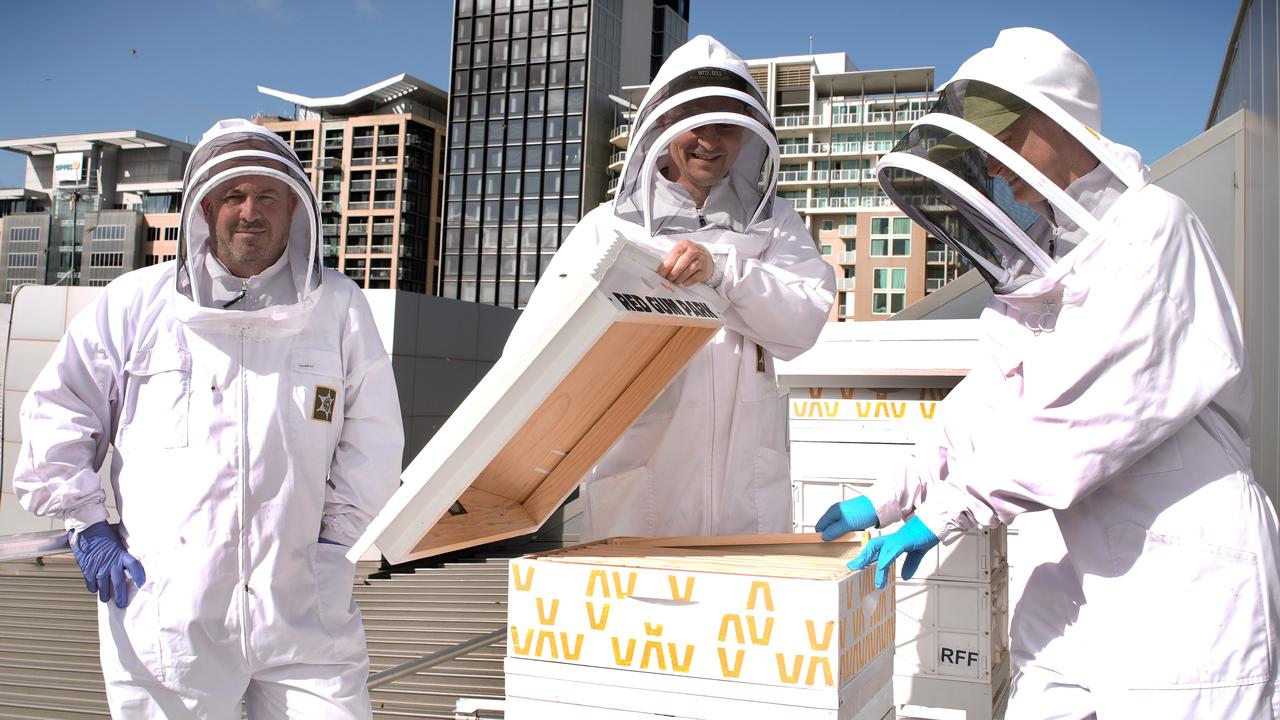
There’s a new buzz at Adelaide Convention Centre and it’s not coming from the thousands of guests moving through every day.
Thirty metres high above the Riverbank Promenade, 250,000 European honey bees have taken up residence.
It’s rooftop royalty with six queens ruling six hives, in wooden huts.
If you’re frightened of bees, you needn’t be. The bees now residing in the Riverbank Hive are too busy working to bother us.
Their prime real estate allows them easy access to the River Torrens, Botanic Gardens, city parks, trees and garden beds where there’s always something in bloom.
Their daily commute is a spectacular sight.
Like planes departing and arriving from an airport runway, the bees launch from the rooftop in swarms, returning a few hours later, laden with precious pollen.
Their work is vital in supporting food production, biodiversity and healthy ecosystems.
It’s estimated that one third of the food we eat depends on bee pollination.
Adelaide Convention Centre chefs Callan Berry and Melinda Fleetwood are trained apiarists and the project’s beekeepers.
Caring for bees is their hobby at home. Taking that hobby to the rooftop at work has been fascinating.
“You can see the bees coming back to the roof with pollen on their legs, like little orange Cheetos legs,” he says.
“They have nectar and as they come in to land they kind of miss the landing because they’re heavy.
“They sort of have their own GPS system where they know exactly where home is, it’s so interesting to see.”
For Callan, tending the hives is about much more than making honey.
“I find working with them to be quite calming, you’re not thinking about anything else but the bees,” he says.
“You’re just in the zone. I like that calming influence they have.”
He’s fascinated by their life cycle and how they communicate through pheromones and movement.
“There’s a thing called the waggle dance that they do to show their sisters where the food is and how far it is,” Callan says.
“They sort of shake in the direction of where the nectar or pollen is and there’s another way they communicate the distance as well.
“When you’re up there and you see them doing the little dance, it’s pretty cute.”
The Convention Centre’s decision to establish the Riverbank Hives is timely – South Australia’s beekeeping industry is facing a serious threat from Varroa mite.
Detected in South Australia for the first time last year, it’s one of the most devastating pests affecting honey bees worldwide.
The tiny parasite has the potential to kill any beehive or colony they infect.
“Bees are struggling, beekeepers are struggling and feral bee colonies will die out so there will be pressure on pollination for food,” Callan says.
“It’s a serious issue but we’re ready for it with our bees, we’ve got all the tools we need to help them.
“We’re going to look after them and they’re going to survive.”
The Riverbank Hive came about after a conversation between Convention Centre executive chef Gavin Robertson and award-winning SA beekeeper, Jake Leske.
It’s not the first in Adelaide – urban apiaries have popped up at the Wayville Showgrounds, the Mayfair Hotel and Adelaide Zoo. But it is believed to be the biggest.
For Gavin, sustainability made the decision easy.
“Without bees there’d be no food,” he says.
“As we all strive to have as much fresh produce coming through our kitchens, it’s crucially important that these bee colonies continue to grow.
“We’re seeing in modern trends that chefs are foraging, and chefs are doing gardens in their own restaurants and wineries, so it’s really satisfying that we can get involved in that at a large scale.”
It’s estimated each hive will produce 50-60kg of honey each year.
The honey is woven through the Convention Centre’s menu, finding its way into pastries, dressings, main courses like honey glazed chicken, and of course, desserts.
The philosophy ties in perfectly with their Honest Goodness initiative, focusing on feel good, whole food, made fresh.
“This is something I’ve wanted to do for many, many years,” Gavin says.
“It’s great to be able to do something that’s going to produce something for us in our own surroundings.”
“It’s good to have that sort of resource on our own doorstep because we know it’s very pure.”
At a time when local beekeepers badly need our support, purity is something we should all be searching for.
We can help by looking beyond the supermarket shelves to find locally grown honey in farmers markets and at regional stalls and stores.
High above the city, six queens and their quarter of a million subjects are doing their bit to remind us how vital the work of bees is. We can do ours too.
That’s a recipe for sweet success.