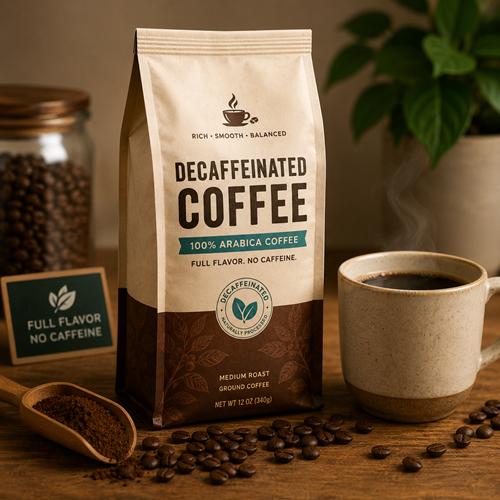
Decaffeinated Coffee Market
The Global Decaffeinated Coffee Market Study, a comprehensive analysis of the market that spans more than 143+ pages and describes the product and industry scope as well as the market prognosis and status for 2025-2032. The marketization process is being accelerated by the market study’s segmentation by important regions. The market is currently expanding its reach.
Key Players in This Report Include:
Starbucks, Nestlé, JDE Peet’s, Lavazza, Dunkin’, Illycaffè, Peet’s Coffee, Death Wish Coffee, Tim Hortons, Caribou Coffee, Keurig Dr Pepper, Nespresso, Tata Coffee, Blue Tokai, Costa Coffee, Strauss Coffee
Request PDF Sample Copy of Report: (Including Full TOC, List of Tables & Figures, Chart) @👉 https://www.htfmarketreport.com/sample-report/4417819-decaffeinated-coffee-market
The global Decaffeinated Coffee market will expand at a compound annual growth rate (CAGR) of 8.40% from 2025 to 2032, from 4.1 Billion in 2025 to 7.8 Billion by 2032.
Our Report Covers the Following Important Topics:
By Type
Swiss Water Decaf, Organic Decaf Coffee, Ready-to-Drink Decaf
By Application
Home Brewing, Café Chains, Office Consumption, Functional Beverages
Definition:
Decaffeinated coffee is coffee from which most of the caffeine content has been removed while preserving the flavor, aroma, and sensory characteristics associated with regular coffee. Decaffeination processes typically remove around 97% or more of caffeine from coffee beans using methods such as solvent-based extraction, Swiss water processing, or carbon dioxide extraction. Decaffeinated coffee is widely consumed by individuals seeking reduced caffeine intake due to health concerns, sleep sensitivity, pregnancy considerations, anxiety management, or lifestyle preferences. The market has evolved significantly with improvements in processing technologies that help maintain taste quality and product authenticity. Specialty coffee brands and premium beverage manufacturers are increasingly investing in high-quality decaffeinated offerings to attract health-conscious consumers.
Dominating Region:
• Europe
Fastest-Growing Region:
• Asia Pacific
Market Drivers:
🔹 Increasing consumer focus on healthier lifestyles and reduced caffeine intake is driving strong demand for decaffeinated coffee products worldwide🔹 Rising awareness regarding sleep quality stress management and wellness benefits is encouraging consumers to switch toward low caffeine beverage alternatives🔹 Expansion of premium coffee culture and specialty beverage consumption is supporting innovation in high quality decaffeinated coffee offerings🔹 Growth in café chains e commerce platforms and ready to drink beverage markets is improving accessibility of decaffeinated coffee products globally🔹 5 Advancements in decaffeination technologies are helping manufacturers preserve flavor aroma and product quality while reducing caffeine content
Market Trends:
🔹 Consumers are increasingly preferring naturally processed and chemical free decaffeinated coffee produced using advanced water or carbon dioxide extraction methods🔹 Specialty coffee brands are launching premium single origin decaffeinated products targeted toward quality conscious and health focused consumers🔹 Demand for organic sustainably sourced and ethically certified coffee products is influencing purchasing decisions within the decaffeinated coffee segment🔹 Ready to drink cold brew and functional beverage innovations are expanding the range of decaffeinated coffee products available in retail channels🔹 5 Coffee retailers are using digital marketing and subscription models to strengthen customer loyalty and increase recurring purchases of decaffeinated coffee products
Market Challenges:
🔹 Maintaining flavor consistency and aroma quality during the decaffeination process remains a major technical challenge for coffee manufacturers🔹 Higher production costs associated with advanced decaffeination technologies can reduce profit margins and increase retail pricing pressures🔹 Consumer perception that decaffeinated coffee lacks taste intensity compared to regular coffee may limit adoption in certain demographics🔹 Fluctuations in global coffee bean supply and agricultural conditions can affect raw material availability and pricing stability across the industry🔹 5 Competition from alternative wellness beverages such as herbal teas and functional drinks may reduce long term demand growth for decaffeinated coffee products
Market Opportunities:
🔹 Rising health awareness among younger consumers creates opportunities for innovative decaffeinated coffee blends with enhanced nutritional and wellness positioning🔹 Expansion into emerging markets with growing café culture and urban populations offers strong growth potential for decaffeinated coffee manufacturers🔹 Collaboration with hospitality chains and food service providers can improve brand visibility and increase institutional demand for decaffeinated beverages🔹 Product diversification through flavored blends plant based beverages and functional ingredients creates opportunities for premium market differentiation🔹 5 Sustainable packaging initiatives and environmentally responsible sourcing strategies can strengthen brand reputation and attract environmentally conscious consumers
Have different Market Scope & Business Objectives; Enquire for customized study 👉https://www.htfmarketreport.com/enquiry-before-buy/4417819-decaffeinated-coffee-market
Geographically, the detailed analysis of consumption, revenue, market share, and growth rate of the following regions:
• The Middle East and Africa (South Africa, Saudi Arabia, UAE, Israel, Egypt, etc.)
• North America (United States, Mexico & Canada)
• South America (Brazil, Venezuela, Argentina, Ecuador, Peru, Colombia, etc.)
• Europe (Turkey, Spain, Turkey, Netherlands Denmark, Belgium, Switzerland, Germany, Russia, UK, Italy, France, etc.)
• Asia-Pacific (Taiwan, Hong Kong, Singapore, Vietnam, China, Malaysia, Japan, Philippines, Korea, Thailand, India, Indonesia, and Australia).
Objectives of the Report:
• -To carefully analyze and forecast the size of the Decaffeinated Coffee
• market by value and volume.
• -To estimate the market shares of major segments of the Decaffeinated Coffee
• market.
• -To showcase the development of the Decaffeinated Coffee
• market in different parts of the world.
• -To analyze and study micro-markets in terms of their contributions to the Decaffeinated Coffee
• market, their prospects, and individual growth trends.
• -To offer precise and useful details about factors affecting the growth of the Decaffeinated Coffee
• market.
• -To provide a meticulous assessment of crucial business strategies used by leading companies operating in the Decaffeinated Coffee
• market, which include research and development, collaborations, agreements, partnerships, acquisitions, mergers, new developments, and product launches.
Evaluate the potential benefits of these trends for your operational needs👉 https://www.htfmarketreport.com/buy-now?format=1&report=4417819
Key Points Covered in Decaffeinated Coffee
Report:
– Decaffeinated Coffee Overview, Definition and Classification Market drivers and barriers
– Decaffeinated Coffee Market Competition by Manufacturers
– Decaffeinated Coffee Capacity, Production, Revenue (Value) by Region (2026-2033)
– Decaffeinated Coffee Supply (Production), Consumption, Export, Import by Region (2026-2033)
– Decaffeinated Coffee Production, Revenue (Value), Price Trend by Type {Swiss Water Decaf, Organic Decaf Coffee, Ready-to-Drink Decaf, Others}
– Decaffeinated Coffee Market Analysis by Application {Home Brewing, Café Chains, Office Consumption, Functional Beverages}
– Decaffeinated Coffee Manufacturers Profiles/Analysis Decaffeinated Coffee Cost Analysis, Industrial/Supply Chain Analysis, Sourcing Strategy and Downstream Buyers, Marketing
– Strategy by Key Manufacturers/Players, Connected Distributors/Traders Standardization, Regulatory and collaborative initiatives, Industry road map and value chain Market Effect Factors Analysis.
Key Questions Answered:
• How feasible is Decaffeinated Coffee
• market for long-term investment?
• What are influencing factors driving the demand for Decaffeinated Coffee
• near future?
• What is the impact analysis of various factors in the Global Decaffeinated Coffee
• market growth?
• What are the recent trends in the regional market and how successful they are?
Thanks for reading this article; you can also get individual chapter-wise sections or region-wise report versions like North America, LATAM, Europe, or Southeast Asia.
Contact Us:
Nidhi Bhawsar (PR & Marketing Manager)
HTF Market Intelligence Consulting Private Limited
Phone: +15075562445
sales@htfmarketintelligence.com
About Author:
HTF Market Intelligence is a leading market research company providing end-to-end syndicated and custom market page, consulting services, and insightful information across the globe. With over 15,000+ page from 27 industries covering 60+ geographies, value research page, opportunities, and cope with the most critical business challenges, and transform businesses. Analysts at HTF MI focus on comprehending the unique needs of each client to deliver insights that are most suited to their particular requirements.
This release was published on openPR.