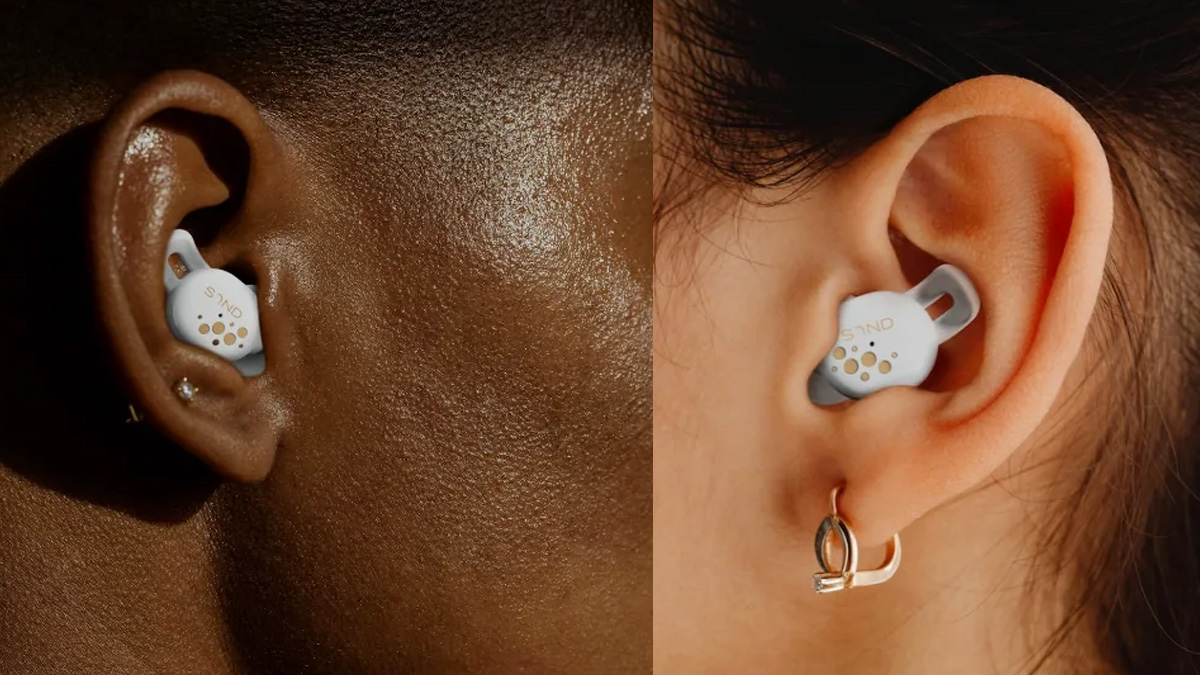
SOND, a Boston-based sleep technology company unveiled Dreambuds, an in-ear sleep system designed to sense the body overnight. The company’s goal is to enhance sleep quality through real-time sensing, adaptive audio, and AI-guided sleep support. Founded in 2022 by MIT graduates with prior experience at Bose and Google, SOND has secured $7 million in funding from E14 Fund, Crosslink Capital, and Ubiquity Ventures. The company collaborates with leading sleep researchers from Harvard Medical School and UT Dallas.
SOND, a Boston-based sleep technology company unveiled Dreambuds, an in-ear sleep system designed to sense the body overnight. The company’s goal is to enhance sleep quality through real-time sensing, adaptive audio, and AI-guided sleep support. Founded in 2022 by MIT graduates with prior experience at Bose and Google, SOND has secured $7 million in funding from E14 Fund, Crosslink Capital, and Ubiquity Ventures. The company collaborates with leading sleep researchers from Harvard Medical School and UT Dallas.

SOND emerged from stealth in May 2026 with the unveiling of Dreambuds, a true wireless in-ear platform that captures twelve physiological signals overnight — including seismocardiography from the ear canal — and responds in real time with adaptive audio, active noise cancellation, and a generative AI sleep coach. The Kickstarter campaign quickly far exceeded its funding target.
The signal that most sharply distinguishes Dreambuds from existing consumer sleep audio devices is seismocardiography (SCG). Traditionally, SCG captures the low-frequency mechanical vibrations imparted to the thorax by cardiac activity — a technique confined to clinical settings, where a chest-strapped accelerometer records a few minutes of data at a time.
SOND claims Dreambuds are the first commercially available device to perform continuous SCG from the ear canal, sustained across a full night of sleep. The approach leverages the acoustic coupling between the chest wall and the ear to derive cardiac timing information with a precision that pulse oximetry and standard photoplethysmography (PPG) cannot provide, particularly for measuring subtle beat-to-beat interval dynamics that are central to heart rate variability (HRV) assessment.
Alongside SCG, the earbuds monitor heart rate, continuous HRV, respiration rate, respiratory effort, cardiorespiratory coupling, real-time sleep staging across light, deep, and REM phases, body position, motion, skin temperature, and ambient sound. The snoring detection subsystem, marketed as Snore-Shield Technology, identifies the characteristic frequency signature of snoring — including that of a bed partner — and applies dynamic audio masking to counteract it. The microphone also supports voice interaction with the onboard AI coach, removing the need to reach for a phone during the night. SOND is explicit that the device is not FDA-cleared as a medical device, though the architecture is described as designed to support future research applications.
The earbuds weigh 2.1 grams each and are built around a PC-ABS body with medical-grade silicone contact surfaces. For a device intended to be worn for eight or more hours in a sleeping position, fit compliance is a recognized engineering challenge. SOND addresses this with its patented Tranquilock system, which pairs three eartip sizes with three silicone retention piece sizes to yield nine fitting combinations — a more granular approach to anatomical variation than the two- or three-size kits typical in consumer earbuds. The low-profile geometry is specifically contoured for side sleepers, where conventional earbud housings create uncomfortable pressure against the pillow.

Adaptive Audio and the Closed-Loop Architecture
The audio subsystem centers on wideband, high-fidelity drivers paired with smart active noise cancellation rated at up to 30dB. The ANC implementation is tuned specifically for the sleep environment rather than the commuter or office contexts that shape most commercial ANC products: prior to sleep onset it attenuates ambient noise in the conventional manner, and once the staging algorithm determines that the user has transitioned into sleep, the system shifts to an audio masking mode that operates independently of ongoing phone connectivity.
Sleep plans are offloaded to the Wi-Fi–enabled charging case, allowing the earbuds to function in a fully standalone configuration throughout the night. Battery life is rated at approximately twelve hours in sensing-only mode and approximately nine hours when audio masking is active — workable margins for most sleep durations.
The content library encompasses more than 500 audio programs spanning meditations, ASMR recordings, soundscapes, sleep stories, sleep music, and paced breathing exercises. Generative AI extends this library on demand: users can request custom breathing sequences or sleep stories on arbitrary topics, which are synthesized and delivered through the earbuds without requiring a streaming connection. The AI Sleep Coach — cloud-based and voice-interactive — learns individual physiological patterns over time and adapts both the audio programming and alarm timing accordingly. The Smart Sleep-Cycle Alarm uses real-time staging data to target wake-up at a lighter sleep phase, a strategy associated with reduced sleep inertia.
Scientific advisors for the solution include Robert Stickgold, PhD, of Harvard Medical School, whose work on sleep and memory consolidation is widely cited, and Eti Ben Simon, PhD, of the Center for BrainHealth at UT Dallas.

The charging case is an atypically capable peripheral, weighing only 106.9 grams, and incorporates an OLED display, physical controls, a built-in speaker capable of serving as a standalone alarm, and both Wi-Fi and Bluetooth radios. The device integrates with Apple Health and Google Health Connect and supports a Find My Device function. SOND offers a free Core subscription tier that includes the full data set, AI coaching, and the complete soundscape library without recurring fees, with optional premium tiers available.
SOND’s Kickstarter campaign, launched May 27, 2026 and closing around June 26, has raised over half a million dollars from more than a thousand backers — well beyond the campaign’s stated goal, and recognized by Kickstarter with its “Project We Love” designation. Each pledge includes the earbuds, the Smart Wi-Fi Charging Case, the full Tranquilock fitting kit, a USB-C cable, six eartips, and a two-year warranty.
SOND’s production timeline calls for a pilot manufacturing run and regulatory certifications — FCC, CE, and Bluetooth SIG — in Q3 2026, with shipping to early backers targeted for Q4 2026 and remaining backer fulfillment extending into Q1 2027.
www.sond.com
