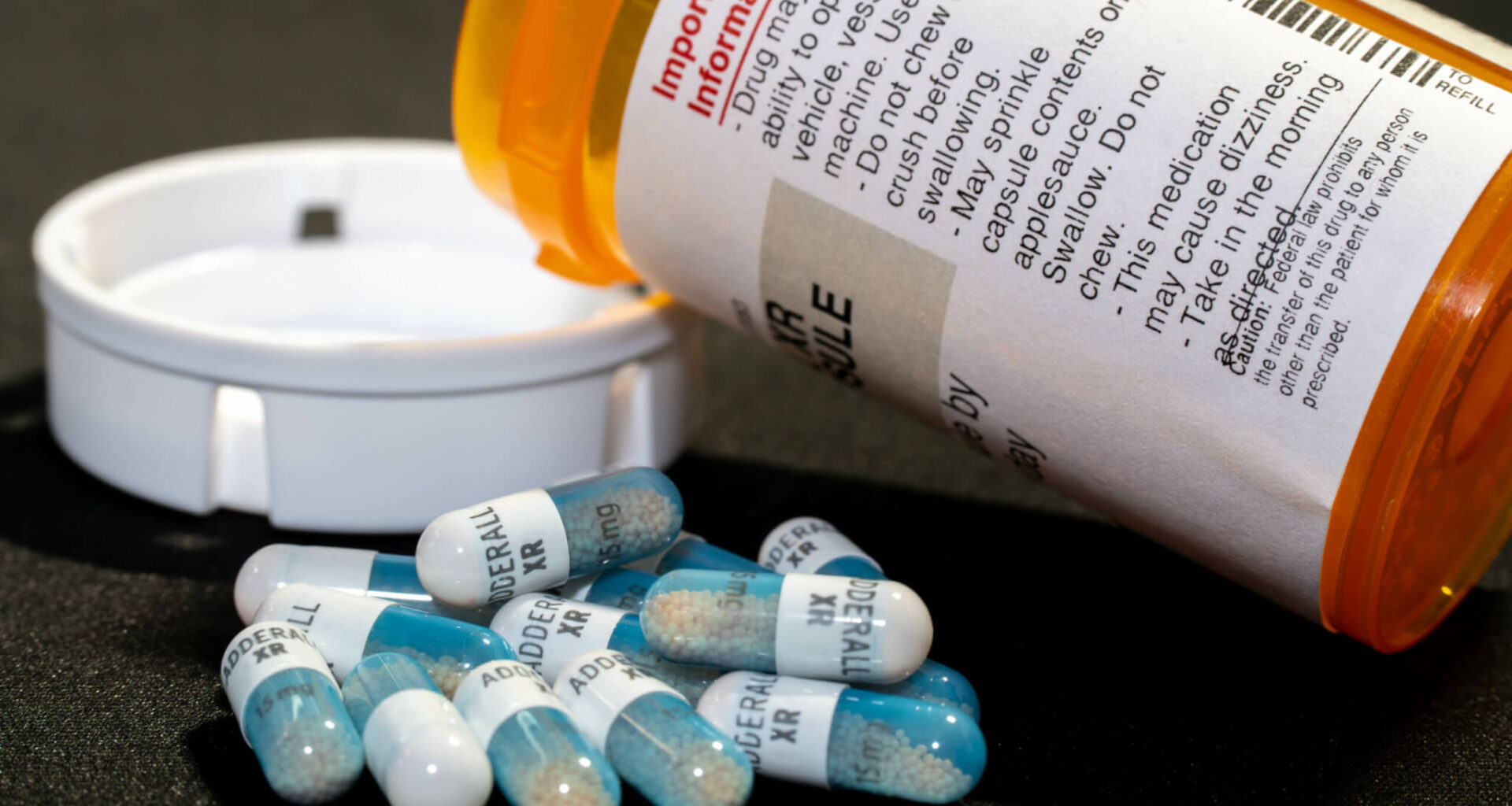

Adderall is commonly prescribed medication for ADHD. (© Alex DiStasi – stock.adobe.com)
Stimulants Mimic A Night Of Sound Sleep Rather Than Directly Boost Attention
In A Nutshell
- Not attention networks: ADHD medications primarily affect brain regions controlling arousal and wakefulness, not the attention networks scientists believed they targeted for 80+ years.
- Sleep connection: Taking stimulants produced brain patterns nearly identical to getting adequate sleep. Sleep-deprived kids’ brains were temporarily “rescued” by medication.
- No cognitive boost for well-rested kids: Children without ADHD who got enough sleep saw zero improvement in grades or test scores from stimulants, only faster reaction times.
- Still works for ADHD: Medications help children with ADHD by increasing wakefulness and making boring tasks feel more rewarding, not by enhancing attention circuits as previously thought.
Taking an ADHD medication produces brain patterns nearly identical to those of getting a good night’s rest, according to the largest brain imaging study of stimulant drugs ever conducted. The finding challenges decades of assumptions about how these medications work and raises a practical question for families and clinicians: for some kids, how much of “focus trouble” is actually a sleep problem in disguise?
Researchers from Washington University School of Medicine analyzed brain scans from 11,875 children ages 8-11 and found that stimulants like Ritalin and Adderall primarily affect regions associated with arousal and wakefulness, not the attention networks doctors have long believed they targeted. The brain changes closely matched those seen when comparing well-rested versus sleep-deprived children.
Most remarkably, children who hadn’t gotten enough sleep but took stimulants showed brain patterns indistinguishable from well-rested children. The medications appeared to rescue the brain from sleep deprivation, at least temporarily.
Not the Attention Networks After All
For decades, scientists believed ADHD medications worked by boosting activity in brain networks responsible for attention and cognitive control. The new findings, published in Cell, paint a different picture.
Among 5,795 children with complete high-quality brain scan data, 337 had taken a stimulant on the morning of their scan. The largest medication-related changes appeared in brain regions linked to arousal and wakefulness, not in the regions scientists have long associated with focus and concentration. The study was large enough to easily detect even small changes in attention networks, yet found none.
The second-biggest effects occurred in brain regions governing reward. These systems help determine which tasks are worth pursuing. Rather than improving attention directly, stimulants may make boring tasks feel more rewarding, increasing persistence without boosting cognitive ability.

ADHD drugs help children improve their focus and concentration, but not by targeting parts of the brain that control attention. (© ShunTerra – stock.adobe.com)
The Sleep Crisis Connection
The sleep connection may explain more than how stimulants work. In this study, only about half of kids reported getting the recommended 9 hours of sleep per night. Among children in the full study cohort taking stimulants on scan day, only 20.7% met the study’s strict ADHD criteria, though most met broader diagnostic standards.
The behavioral data reinforced the sleep link. Children with less sleep who took stimulants showed the clearest improvements in school grades. Well-rested children without ADHD saw no academic benefit from the medications. Stimulants appeared to compensate for insufficient rest rather than boost cognitive abilities beyond normal.
Sleep duration itself was associated with improvements in school performance, cognitive test scores, and working memory. Getting adequate sleep provided benefits similar to those stimulants offered children with ADHD or sleep deprivation.
Researchers measured brain activity while children rested in a scanner, then confirmed their findings in a controlled study where five adults were scanned extensively, both with and without Ritalin. The adult study showed the same patterns: decreased activity within motor and sensory networks and increased connections between those regions and reward systems, with no changes in attention networks.
To further confirm the arousal connection, researchers compared their findings against three independent brain studies using different measurement techniques. All three pointed to the same conclusion: stimulants primarily affect the brain’s wakefulness system.
The cognitive testing data aligned with these brain findings. Among children without ADHD who got adequate sleep, taking stimulants provided no improvement in school grades, standardized test scores, or accuracy on working memory tasks.
Benefits were concentrated in two groups: children diagnosed with ADHD and children who weren’t getting enough sleep. For children with ADHD, stimulants brought their performance up to their peers’ level. For sleep-deprived children regardless of ADHD status, stimulants showed the clearest benefit in improving school grades.
This pattern shows stimulants work less by boosting cognitive ability and more by compensating for deficits in arousal and motivation. The one universal effect was faster reaction times, which improved by about 100 milliseconds across all children taking stimulants.

Poor sleep could be a critical driver of ADHD symptoms. (Photo by SB Arts Media on Shutterstock)
The Smart Drug Myth
The findings cast doubt on the widespread belief that stimulants act as cognitive enhancers for people without ADHD. While these medications are increasingly used by students and professionals seeking a mental edge, the study found no cognitive benefits among well-rested children without attention problems.
Previous research has shown that people taking stimulants often feel their performance has improved even when objective measurements show no benefit or slight impairment. The subjective confidence boost doesn’t match reality for those already performing well.
The study confirmed a well-established pattern: stimulants help low-performers more than high-performers. The medications appeared to bring underperforming children (whether due to ADHD or sleep deprivation) up to baseline rather than elevating anyone’s abilities above normal.
There’s no question as to whether stimulant medications help children with ADHD. The data clearly shows they do. Children with ADHD who took stimulants showed improvements in school grades and cognitive test performance compared to those who didn’t take medication.
Rather, the study reframes how these medications work. Instead of directly boosting attention circuits, stimulants increase general arousal and boost the motivational value of tasks. This makes them effective for ADHD not because they improve focus per se, but because they increase drive to persist at unrewarding activities and reduce task-switching behavior.
The research included children taking various formulations: methylphenidate (Ritalin), dexmethylphenidate (Focalin), mixed amphetamine salts (Adderall), and lisdexamfetamine (Vyvanse). All showed similar brain patterns despite chemical differences between drugs.
A Warning About Masking Sleep Problems
While stimulants temporarily rescued brain activity in sleep-deprived children, researchers warn this doesn’t make sleep deprivation acceptable. Growing evidence points to serious long-term consequences of insufficient sleep in children, including increased risk of depression, cellular stress, and neuronal loss.
The rescue effect appears to work only while medication is active. What happens when drug levels drop in the afternoon remains unclear. The researchers note that mounting evidence points to cumulative health consequences of long-term sleep deprivation. The short-term brain improvements don’t address the broader health impacts of chronic insufficient rest.
Since sleep disturbance is both a common symptom of ADHD and a frequent side effect of stimulant treatment, the research prompts doctors to carefully assess sleep problems before and after prescribing these medications.
Parents might question whether their child’s attention problems stem from ADHD or simply from not getting enough rest. The study shows that addressing sleep issues could provide some of the same cognitive benefits as medication without pharmaceutical intervention.
Among children in the full study cohort, 7.8% were prescribed stimulants and 6.2% took them on scan day. The medications are used for various conditions beyond ADHD, including traumatic brain injury, narcolepsy, and as appetite suppressants, reflecting real-world prescribing patterns.
The research represents one of the largest brain imaging studies of stimulant medications ever conducted. However, limitations exist. The study lacked precise information about medication timing and formulation for individual children, which could have led to underestimating medication effects. The study also couldn’t separate effects of specific medications or ADHD subtypes.
These medications work, but perhaps not the way doctors and patients have long believed. Rather than fine-tuning attention circuits, stimulants appear to solve attention problems by increasing wakefulness and making tasks feel more rewarding. For the millions of American children prescribed these drugs, the research doesn’t change whether they should take them. But it does change how we understand what the medications are doing in their brains.
Paper Summary
Limitations
The researchers note several limitations to their findings. The study examines a large, diverse group of children taking different stimulant medications and diagnosed with various ADHD subtypes, which reflects real-world treatment but limits the ability to investigate effects of specific drugs or diagnostic categories. The ABCD Study lacked precise data on medication timing and formulation (immediate versus delayed release) for individual participants, which may have led to underestimating the effects of stimulants on brain connectivity. The study could not account for all pharmacokinetic factors that influence how drugs work in the body. The term “attention” is itself imprecise and multifaceted, making it difficult to directly compare findings across different studies that may define and measure attention differently. Comparison with previous research is complicated by limited availability of source data from earlier studies and the use of different brain parcellation methods and network definitions across studies. The precision imaging validation study, while providing highly detailed data from each participant, included only five healthy adults without ADHD, limiting statistical power for some analyses. The study focused on acute effects during scanning and did not assess longer-term effects or what happens when medication wears off.
Funding and Disclosures
This work was supported by multiple grants from the National Institutes of Health (NIH) including EB029343, MH121518, MH129493, NS123345, NS098482, DA041148, DA04112, MH115357, MH096773, MH122066, MH121276, MH124567, NS129521, NS133486, NS140256, DA057486, and MH129616. Additional funding came from the National Spasmodic Dysphonia Association, Mallinckrodt Institute of Radiology pilot funding, the McDonnell Center for Systems Neuroscience, the Behavior Research Foundation, the Taylor Family Institute Fund for Innovative Psychiatric Research, and the Extreme Science and Engineering Discovery Environment (XSEDE) Bridges at the Pittsburgh Supercomputing Center. Two of the senior authors (D.A.F. and N.U.F.D.) disclosed financial interests in Turing Medical and may benefit financially if the company successfully markets FIRMM motion-monitoring software products. They may receive royalty income based on FIRMM technology developed at Washington University School of Medicine and Oregon Health and Sciences University and licensed to Turing Medical Inc. Both are co-founders of Turing Medical Inc. These potential conflicts of interest are reviewed and managed by Washington University School of Medicine, Oregon Health and Sciences University, and the University of Minnesota. The data used in this study came from the Adolescent Brain Cognitive Development (ABCD) Study, a multi-site longitudinal study funded by the National Institutes of Health and additional federal partners.
Publication Information
Title: Stimulant medications affect arousal and reward, not attention networks
Authors: Benjamin P. Kay, Muriah D. Wheelock, Joshua S. Siegel, Deanna M. Barch, Damien A. Fair, Nico U.F. Dosenbach, and colleagues from Washington University School of Medicine in St. Louis, University of Minnesota, Oregon Health & Science University, and other institutions. The lead contact and corresponding author is Benjamin P. Kay ([email protected]).
Benjamin P. KayJournal: Cell, Volume 188, Issue 26, Pages 7529-7546.e20, December 24, 2025 | DOI: S0092-8674(25)01373-X
The study was published as open access. Data are publicly available through the ABCD Study database (doi: 10.15154/1503209) and Zenodo (doi: 10.5281/zenodo.17916532).