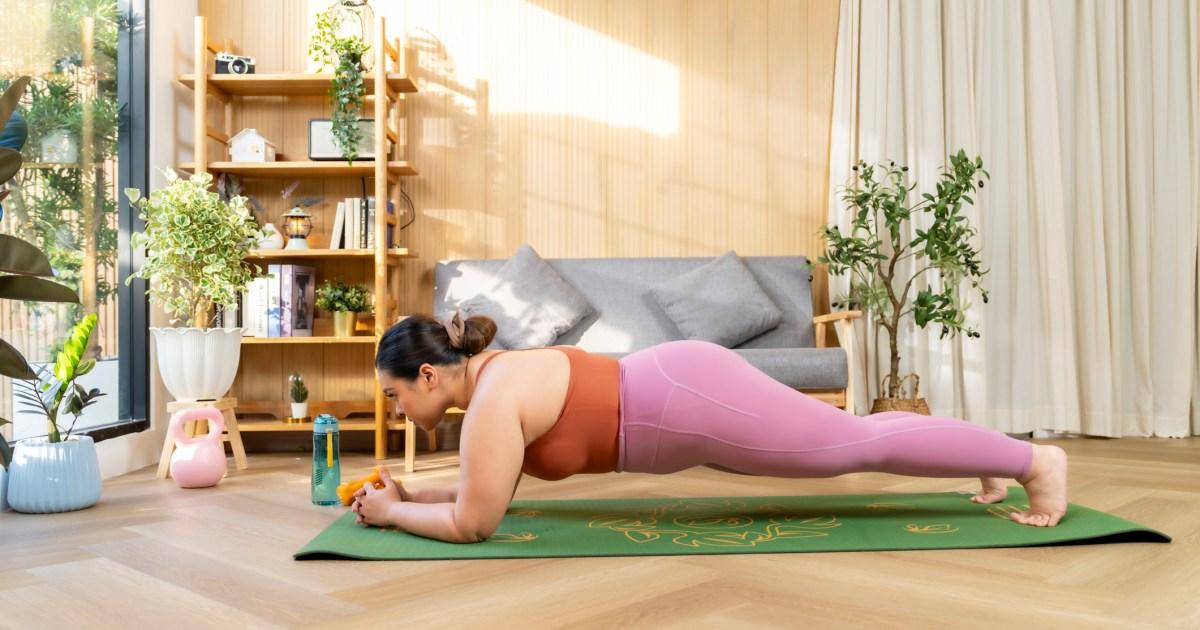
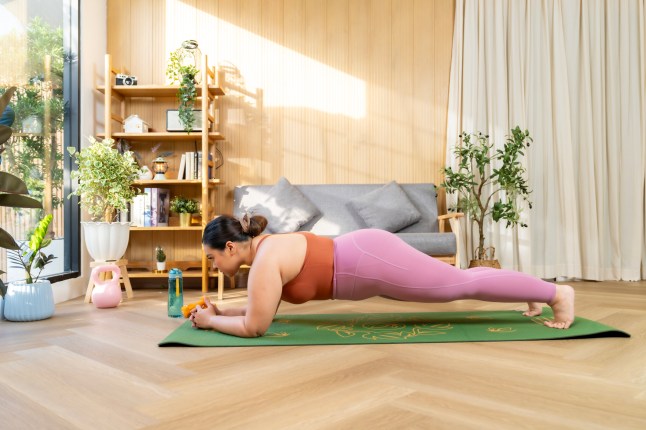
It’s important to focus on technique too (Picture: Getty Images)
Along with burpees and split squats, the plank is one of those exercises that no one really like doing.
No matter how long you’ve been horizontal for, holding one feels like an eternity. Seconds turn to hours as your body start to shake and your brain screams: ‘Stop this NOW.’
The annoying thing though, is that this core strengthening exercise is undeniably effective. But just how long are you meant to be able to hold it?
The record for the longest plank was set by Josef Salek from the Czech Republic in May 2023 — an unbelievable 9 hours and 38 minutes, around an hour longer than a flight from London to New York.
Muscles aching just thinking about it? Well, thankfully, the average person doesn’t need to spend a full day in agony.
Rowan Clift, training and nutrition specialist at Freeletics, tells Metro that the exercise is about ‘quality, not quantity’. However, there are some parameters, depending on your age, which can be a useful guideline for your next workout.
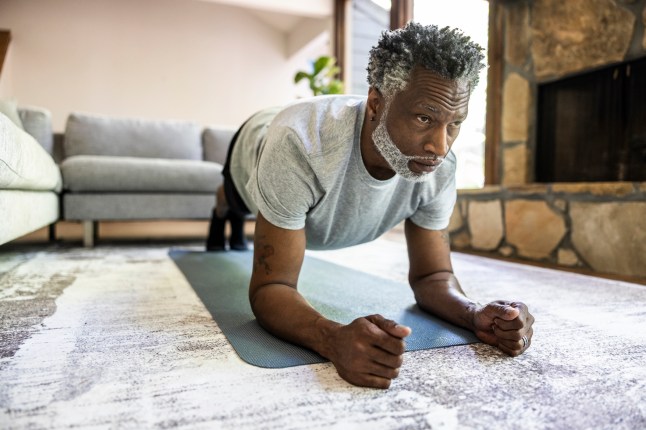
You should set targets on capability, not age (Picture: Getty Images)
Aged 20-39: 45-60 seconds
‘In your 20s and 30s, being able to plank for 45-60 seconds is a solid marker of good core endurance,’ says PT Joseph Webb, who has been in the fitness industry for 17 years.
But, Joseph adds: ‘The purpose of a plank isn’t to chase an arbitrary number. It’s to build usable core stability that supports what you want to do outside of the gym.’
It might take some trial and error achieving a plank. As a starting point, put yourself in the position of, well, a plank. Use your forearms and toes to hold yourself parallel to the ground, with your back and legs straight (not arched).
Joseph adds it’s important to ‘keep hips level with shoulders, squeeze glutes and engage thighs, and maintain a natural neck position.’
He says: ‘Brace your abdominals as if preparing for a punch, but keep your breathing fluid, as if you’re sitting on the couch.
‘Sagging hips, flared ribs or strained shoulders mean you’re no longer training the muscles you think you are.’
Ages 40-59: 30-45 seconds
Joseph says: ‘From my experience working with hundreds of clients in this age range, I’ve found that maintaining a 30-45 second plank with excellent form demonstrates very respectable endurance and trunk stability.’
That doesn’t mean you can’t push yourself though. ‘If you’re able to confidently reach 60 seconds, that’s generally a sign of excellent core control for this age group.’
Adjusting to the technique can be more difficult as you age, however. This can be due to various reasons, including loss of muscle mass and strength.
‘As muscles around the hips, pelvis and spine weaken, or become less coordinated, it takes more effort to stabilise the plank position,’ says Joseph.
‘Those in this age category may also find planking difficult due to joint stiffness or previous injuries, which can make it harder to hold a rigid position.’
Age 60+: 15 to 30 seconds
Joseph advises his clients aged 60 and over to aim for 15 to 30 seconds of a full plank with good form.
‘If you can build up to 30 seconds, that’s an excellent marker of strong functional core endurance at this stage of life.’
Rowan adds that if you’re 60+ and finding the plank difficult, you can modify the exercise to make it a little easier.
He explains: ‘Plank on the knees or with hands elevated on a bench to build strength while reducing pressure on the wrists, shoulders and lower back.’
Find the plank too challenging? Here are some alternative exercises
There are plenty of other core exercises Joseph recommends to people who find planks too challenging, especially for those aged 60 and over.
These include
- Incline plank: Hands on a bench or countertop reduces the load but still engages the core well.
- Kneeling plank: Drop to the knees to reduce the leverage demands while keeping the core braced.
- Bird-dog exercise: On all fours, extend opposite arm and leg while maintaining a stable trunk. Great for core, hips, and back.
Remember: quantity over quality
The most important question to ask yourself is: What’s the goal?
Joseph explains: ‘The purpose of a plank is to to build core stability that supports what you want to do outside of the gym.
‘Whether that’s running, lifting or simply moving well in daily life, the question is: “Is my core doing its job when I need it?”.’
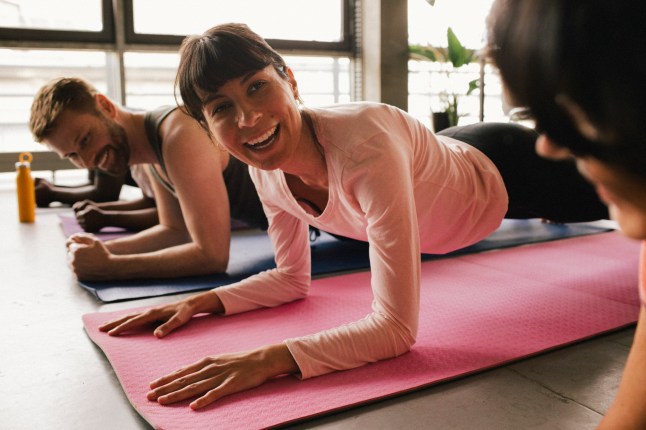
How do you compare to others your age? (Picture: Getty Images/Maskot)
How often should you plank?
Rowan advises incorporating planks into your workout regime three to five times a week. He says: ‘Your core benefits from regular activation, but you do also need to allow time for rest and recovery.
‘Performing planks daily can be fine, especially if you are varying the intensity and duration, but if you’re experiencing fatigue or tightness, have at least one day’s rest.’
You should be careful of pushing yourself too much, Rowan adds. ‘If you experience shaking, holding your breath, pain in your lower back or shoulders, or your hips begin to sag, it’s time to stop. These are signs that muscles have fatigued and your form is breaking down.’
How do you match up to your age mates?
- Some people wake up bursting for the loo multiple times a night, while others can go for a full working day without so much as a single trip to the loo. Where you sit on this scale can say a lot about your overall health.
- If a plank feels a bit too strenuous, why not make like a flamingo, and simply stand on one leg. Research reveals that the length of time you can balance can give an insight into how your ageing.
- People can be pretty secretive about how much money they have in the bank, which means it can be hard to work out if you’re rolling in it, or positively skint. Metro did some digging, to determine the average amount Brits have in their savings, broken down by age group.
This article was originally published in May 2025 and has since been updated.
Do you have a story to share?
Get in touch by emailing MetroLifestyleTeam@Metro.co.uk.
Arrow
MORE: 9 of the most stylish trainers that make walking 20,000 steps bearable
Arrow
MORE: The 5 key things everyone should know about their health — but probably don’t
Arrow
MORE: How long it should take you to run a mile, according to your age
Comments
Add Metro as a Preferred Source on Google
Add as preferred source
The Slice
Your free newsletter guide to the best London has on offer, from drinks deals to restaurant reviews.